
Part 2 of the US–Korea Shipbuilding Series
South Korea is preparing one of the boldest industrial investments ever pledged on U.S. soil. But what exactly does it cover — and what does it mean for America’s shipbuilding future?
THE HEADLINE NUMBER
In late 2024, Seoul confirmed a pledge worth between $150 billion and $200 billion over ten years, tied to industrial cooperation with the United States. While headlines focused on LNG carriers and Philly Shipyard, the scope is much wider. This is about creating a new U.S.–Korea industrial corridor, with shipbuilding at its centre.
For America, the promise is clear: modernise yards, restore capabilities, and anchor naval resilience in the Indo-Pacific era. For Korea, it means securing long-term access to the U.S. market while hedging against Chinese competition.
BREAKING DOWN THE PLEDGE
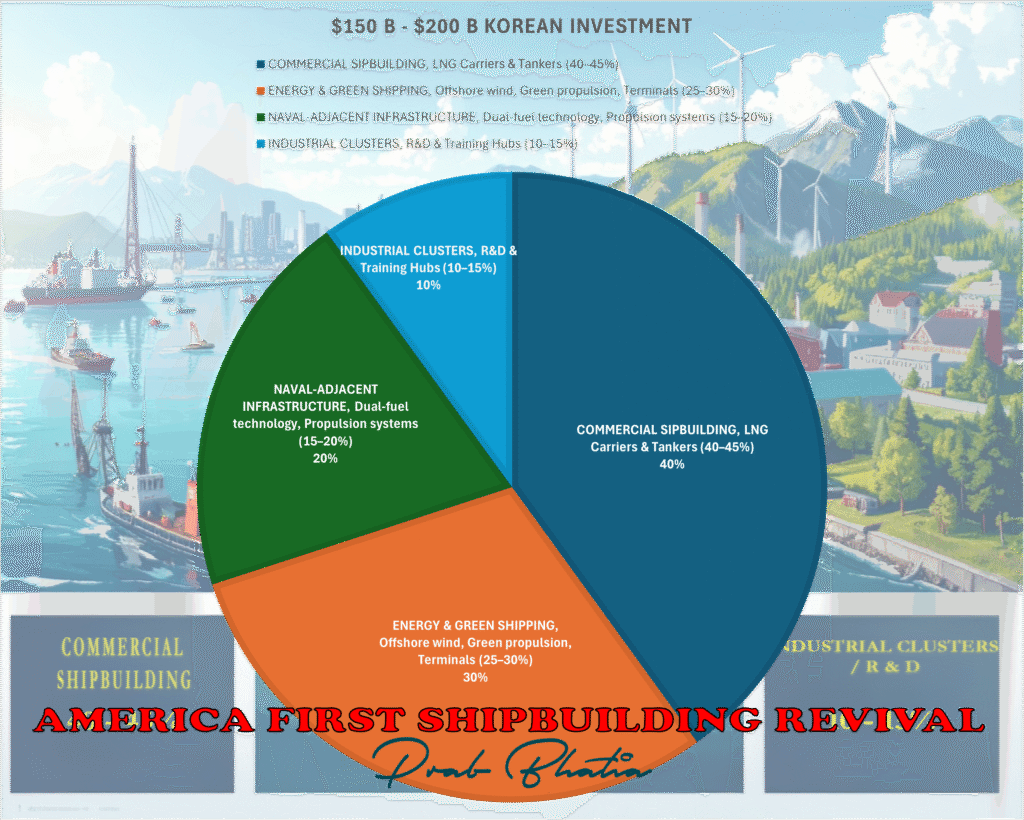
The figure of $150–$200 billion is spread over the next ten years across multiple sectors, all linked to shipbuilding in some way. While details are evolving, the pledge can be broadly broken down into four buckets:
Commercial Shipbuilding (40–45%)
Korea’s expertise in building advanced LNG carriers, tankers, and offshore support vessels will be transplanted to U.S. yards. Philly Shipyard, where Hanwha Ocean has already booked a 10-tanker order, is first in line. Other Gulf Coast yards may follow, especially for LNG-linked projects.
Energy Tie-Ins (25–30%)
Korea is bundling investments with LNG terminals, offshore wind, and green shipping technology. Hyundai’s portfolio, for example, includes not only vessels but also LNG bunkering and clean-fuel propulsion systems.
Naval-Adjacent Infrastructure (15–20%)
U.S. law restricts foreign involvement in direct naval shipbuilding. But “dual-use” spillover—propulsion systems, advanced welding, and automation—is allowed. Expect these technologies to blur the civilian–naval boundary.
Industrial Clusters & R&D (10–15%)
Korea is also targeting digital ship design centres, supplier parks, and workforce training hubs. This involves forming partnerships with universities, community colleges, and suppliers who have previously left the industry, as well as adopting pedagogies that translate advanced Korean shipbuilding practices into American classrooms and workshops.
WHY KOREA IS DOING THIS
For Korea, this is about more than business. Three motivations stand out:
1. Strategic Hedge Against China
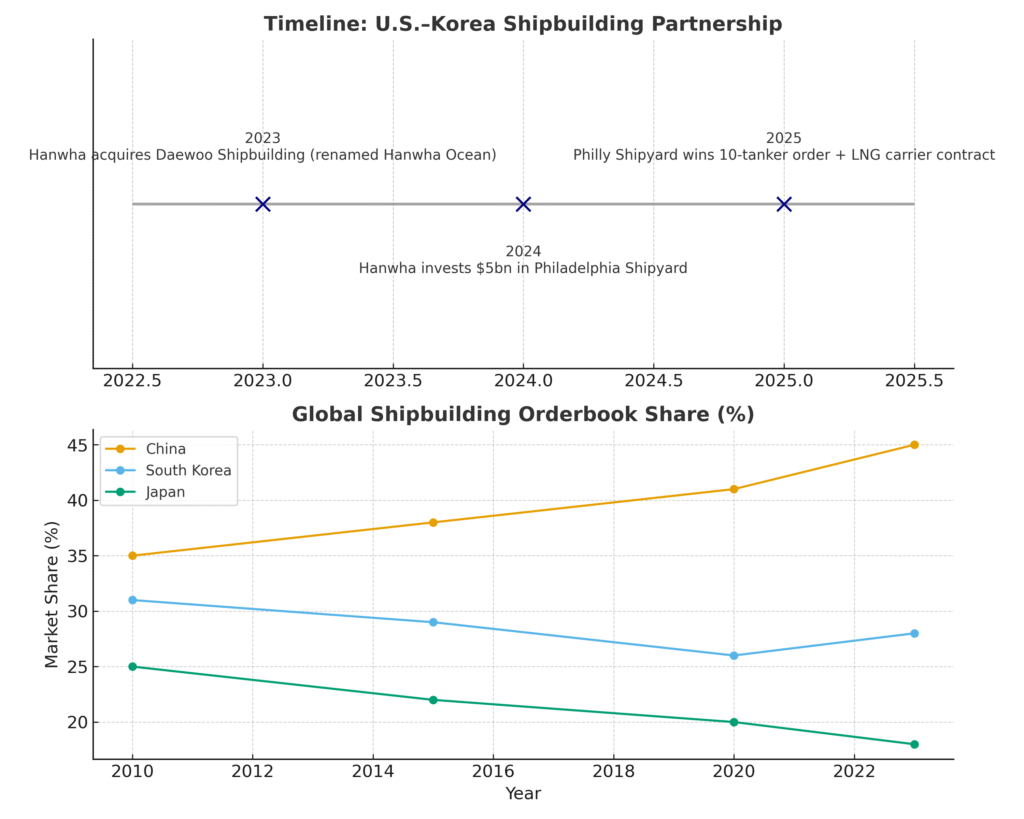
China is now the world’s largest shipbuilder, controlling over 50% of the global order book. Korea needs to diversify its markets and align with the U.S. security umbrella to avoid being squeezed.
2. Technology Export & Standards
By embedding its shipbuilding standards in U.S. yards, Korea ensures its digital design platforms, LNG propulsion systems, and safety protocols become industry benchmarks.
3. Insurance Policy in Washington
Massive U.S. investment insulates Korea’s big three—Hyundai, Samsung, and Hanwha—from protectionist winds. If these firms employ thousands of U.S. workers, it becomes politically harder for Washington to push back.
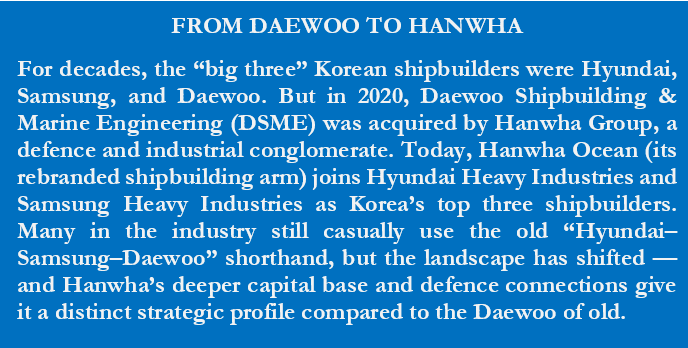
For decades, the “big three” Korean shipbuilders were Hyundai, Samsung, and Daewoo. But in 2020, Daewoo Shipbuilding & Marine Engineering (DSME) was acquired by Hanwha Group, a defence and industrial conglomerate. Today, Hanwha Ocean (its rebranded shipbuilding arm) joins Hyundai Heavy Industries and Samsung Heavy Industries as Korea’s top three shipbuilders. Many in the industry still casually use the old “Hyundai–Samsung–Daewoo” shorthand, but the landscape has shifted — and Hanwha’s deeper capital base and defence connections give it a distinct strategic profile compared to the Daewoo of old.
WHY WASHINGTON LIKES IT
On the American side, the pledge checks multiple boxes:
- Industrial renewal: Reviving blue-collar industries hollowed out since the 1980s.
- Green shipping: Tied to offshore wind, LNG, and alternative fuels.
- Alliance politics: Demonstrates that Washington’s “friend-shoring” strategy is not just theory.
- Jobs, jobs, jobs: Korean investments are estimated to create around 50,000 new jobs, especially in coastal districts.
POLITICS OF THE PLEDGE
The politics are where things get complicated:
- Buy American vs. America First
Under Biden, the pitch was industrial renewal, green energy, and alliances. Under Trump, the rhetoric shifts to “America First shipbuilding revival”. The end goal overlaps, but foreign partners face higher scrutiny and shifting rules.
- Union Dynamics
Labour unions will welcome new jobs but could resist Korean-style management practices that pressure wage standards.
- Defence Restrictions
The law still prohibits foreign firms from building U.S. Navy warships. Any spillover must be carefully structured.
In short, the politics are manageable—if results are visible. Photo ops of tankers under construction in Philadelphia matter as much as balance sheets.
THE ICE RAID FALLOUT
Although South Korea is now one of the largest direct investors in the United States, it has not been shielded from the turbulence of American domestic politics. On September 4, 2025, U.S. Immigration and Customs Enforcement (ICE) staged a high-profile raid at the Hyundai Motor–LG Energy facility in Alabama, detaining nearly 500 workers — including 300 South Koreans — on alleged labour violations. Footage released by ICE showed workers shackled at wrists and ankles, a display that many in Seoul condemned as unnecessarily harsh and politically motivated.
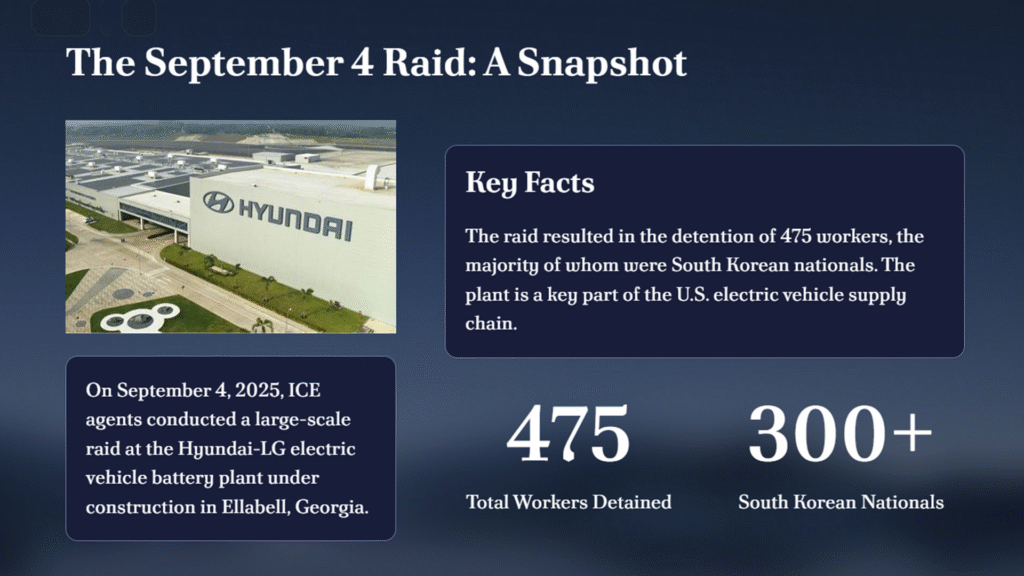
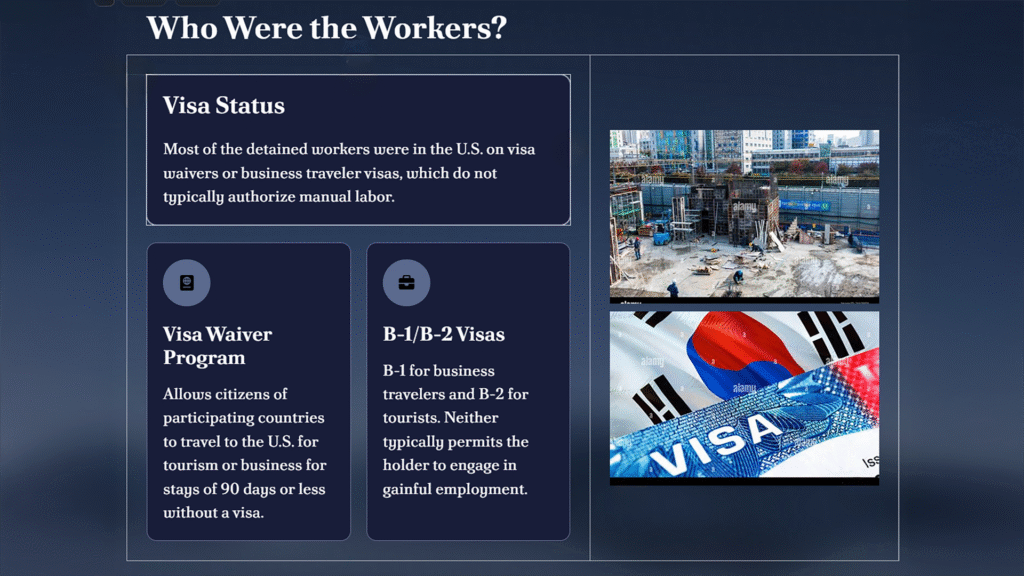
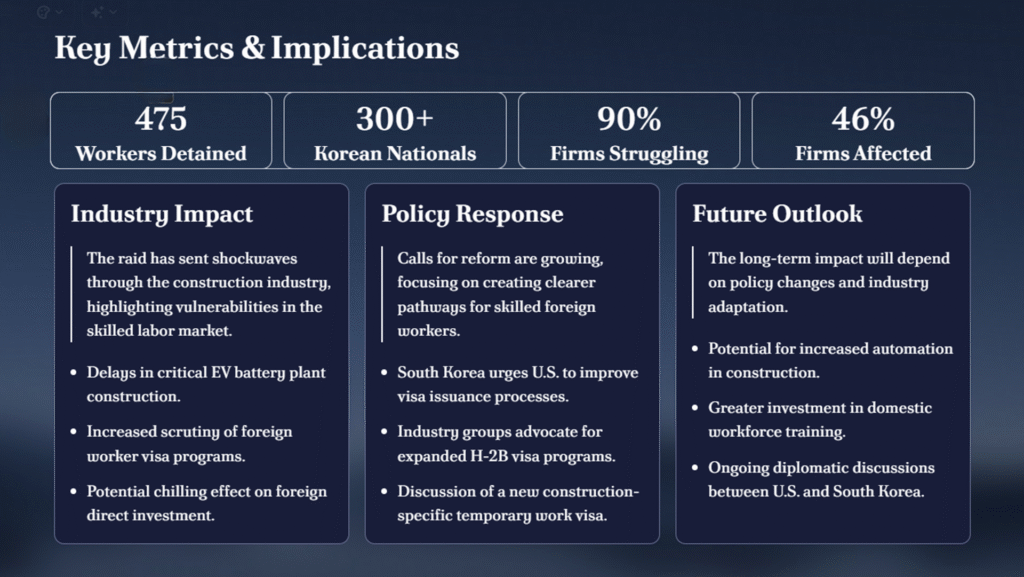
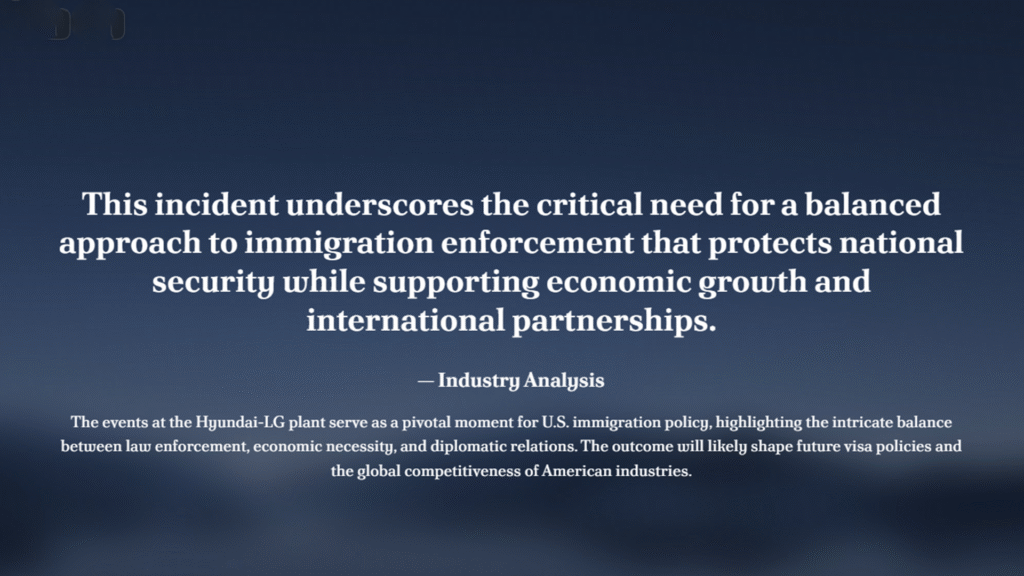
The episode highlighted a deeper vulnerability: strategic industrial partnerships are only as resilient as the political climate that surrounds them. With the Trump administration intensifying immigration enforcement, the risk of similar disruptions remains high. Each such incident threatens not only to derail ongoing projects but also to erode confidence among South Korea’s executives and other foreign investors who may see U.S. policy as unpredictable and punitive.
- Optics matter: Images of shackled workers fuelled outrage in Seoul and raised concerns of politically motivated enforcement.
- Trust deficit: Even as South Korea commits $150–$200 billion to U.S. ventures, incidents like this shake investor confidence.
- Systemic risk: Immigration crackdowns or policy swings can ripple across supply chains and joint ventures, slowing momentum.
Takeaway: Long-term industrial partnerships require not just capital and technology, but also political stability and mutual trust.
THE CHALLENGES AHEAD
Even with billions pledged, success is not guaranteed. Key challenges include:
- Workforce Erosion
America’s shipbuilding workforce has shrunk dramatically since the 1980s. Recruiting, training, and retaining skilled welders, pipefitters, and designers is the single biggest challenge. - Cost Gap with Asia
U.S. shipbuilding costs are 2–3 times higher than China’s. Without subsidies, the commercial sector remains uncompetitive. - ICE Raid Fallout
Labour-related flashpoints with Korean firms risk souring political goodwill.
Execution Risk
Turning pledges into steel on the slipway will require aligning the efforts of governors, unions, suppliers, and communities. Not all promises may materialise.
WHY IT MATTERS
If successful, the pledge will do more than revive a few shipyards. It could:
- Create a bi-national supply chain that links Korean technology to U.S. yards.
- Anchor the U.S. Navy’s industrial resilience by strengthening civilian shipbuilding capacity.
- Provide a credible counterweight to China’s dominance in global shipbuilding.
But if it fails, the result will be more scepticism about industrial renewal — and more reliance on Asian yards for U.S. maritime needs.
THE BOTTOM LINE
South Korea’s $150–$200 billion pledge is not a one-time cheque. It’s a series of long-term commitments: contracts, joint ventures, and supply-chain investments. Together, they add up to a once-in-a-generation bet on America’s shipbuilding future.
The gamble is this: can America rebuild its maritime muscle fast enough and at a competitive enough cost to matter in the age of great power competition?
That’s the story to watch.