

Post 9/9 and the last of the US–Korea Shipbuilding Series: Legacy, labour, and latent potential—India’s maritime ambitions face the test of infrastructure, policy, and global trust.
I still remember my first morning at sea in December 1972—the horizon wide, the sea calm, the engines steady, and a quiet conviction taking shape: that India, a nation shaped by water, would one day reclaim its maritime destiny, and that I might help bring about that change. Five decades later, that question feels more urgent than ever. Can India become the next melting pot of shipbuilding? On paper, the ingredients are undeniable—7,500 kilometres of coastline, abundant steel, a vast technical workforce, and a dense network of maritime institutions. Yet our share of global newbuilding remains below 0.1%, a whisper in an industry we once hoped to influence. How did a country built for the sea drift so far from its own shoreline of possibilities?
A FORGOTTEN LEGACY OF MARITIME EXCELLENCE
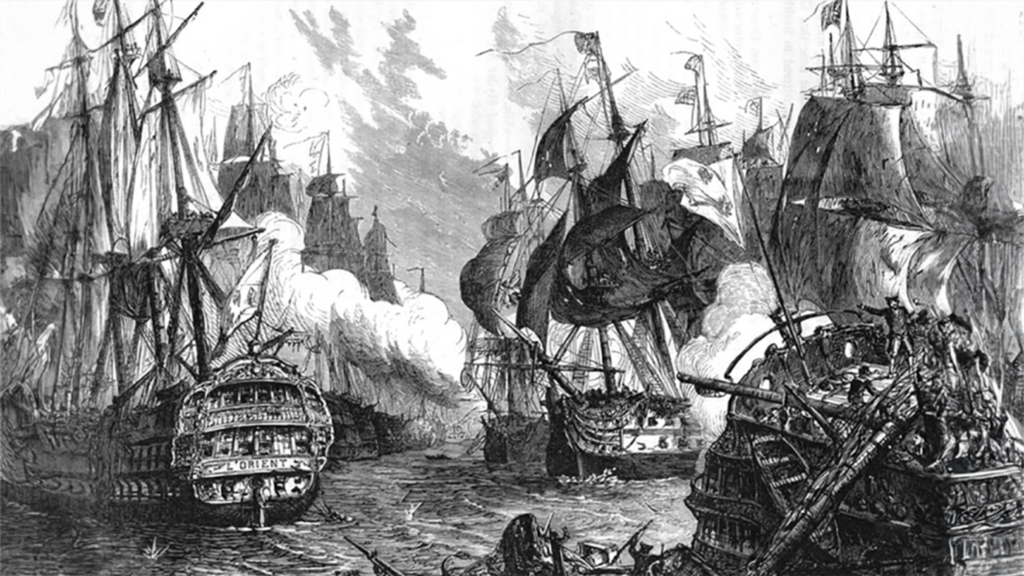
Long before South Korea and China emerged as shipbuilding superpowers, India was already far ahead. As I explored in my book, Blocking India’s Shipbuilding Mise‑en‑Scène (June 2025), Indian shipyards once produced formidable commercial vessels and warships for the British Navy. This isn’t mythology or some 5,000-year-old folklore recycled through Chinese whispers and parroted by politicians from podiums to stir sentiment. These are documented historical facts. In the 18th and 19th centuries, Indian shipyards built high-quality merchant and naval vessels for the British Empire — ships that sailed into battle, crossed oceans, and in some cases, still float in British museums today. The craftsmanship of Indian shipbuilders, especially the Bombay Dockyard under the Parsi leadership of Jamshedji Bomanjee Wadia since 1736, was renowned across the maritime world. Their vessels were known for durability, speed, and elegant construction — a testament to India’s deep maritime heritage. India had the infrastructure, the talent, and the reputation. What it lacked — and still lacks — is the strategic vision to scale that legacy into a modern industrial force.
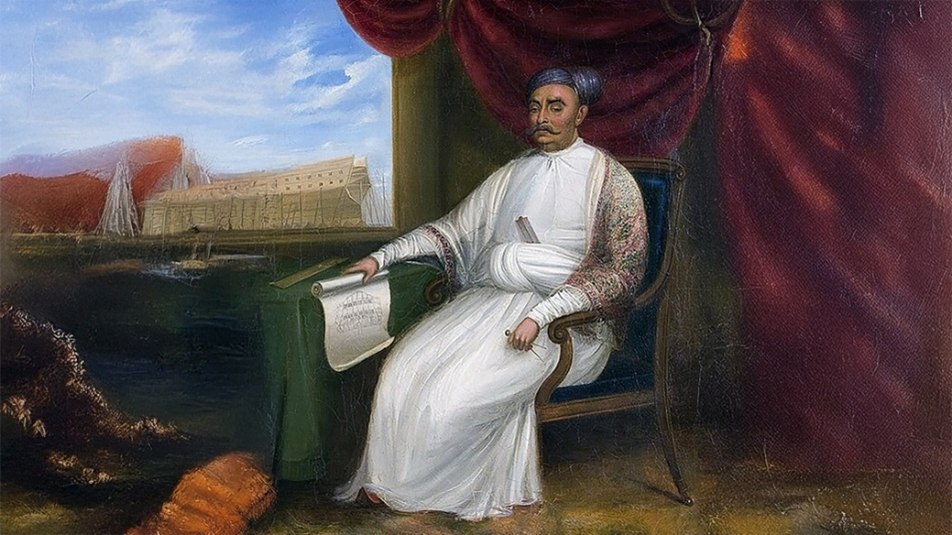
The Bombay Dockyard of that era has since been absorbed into the state system and is now known as the Indian Naval Dockyard, where I myself completed my apprenticeship. Its role today is limited to the repair and refit of naval assets, such as frigates, submarines, and aircraft carriers, rather than the construction of new vessels.
In 1776, an offshoot of this legacy, Mazagaon Dock Shipbuilders Ltd., evolved into a modern naval shipyard capable of designing and building submarines and advanced warships. Yet, when viewed against the scale of global shipbuilding giants, Mazagaon Dock remains modest, producing a small number of vessels each year and barely registering on global shipbuilding statistics.
INDIA’S EARLY LEAD — AND THE LOST CONTINUITY
When India gained independence in 1947, it inherited something that China and South Korea did not: a functioning industrial and shipbuilding ecosystem.
By the 1870s, Jamalpur and Ajmer were assembling locomotives. By the 1890s, India was manufacturing complete steam engines. By the 1940s, Indian workshops could overhaul American wartime locomotives and adapt them to local conditions.
Shipbuilding had an equally deep lineage:
- Bombay Dockyard was building warships in the 1700s.
- Garden Reach was producing steamers in the 1800s.
- Visakhapatnam and Mazagaon had the foundations of modern yards.
By 1947, India possessed:
- Scindia Shipyard (Visakhapatnam, est. 1941)
- Mazagaon Dock (Bombay)
- Garden Reach (Calcutta)
- Hooghly Dock
- British‑era dry docks and repair facilities
- A trained workforce from naval dockyards
- A long coastline and an English-speaking maritime labour pool
In short, India had the ingredients of a shipbuilding superpower long before Asia’s later champions even began.
But instead of scaling this foundation, India chose a path that gradually eroded its advantage. Industrial assets created under colonial rule were viewed as tainted symbols of exploitation rather than platforms for future strength. Emotional and ideological priorities overshadowed the cold logic of industrial continuity.
Shipyards were nationalised. Private enterprise was discouraged. No supplier ecosystem emerged. No export strategy was pursued. Over time, once‑promising facilities became uncompetitive and isolated from global markets.
The consequences are visible today: India spends billions buying ships from abroad, sends vessels overseas for repairs, and imports even basic marine spares that could have been manufactured domestically.
The direction chosen after independence shaped the next seven decades of maritime history.
A VISION FOCUSED ON SEAFARERS, NOT SHIPBUILDERS
As I wrote in Blocking India’s Shipbuilding Mise en Scène (June 2025), Jawaharlal Nehru—on at least two occasions, including the inauguration of the new DMET building in Calcutta in 1953—described Indian seafarers as “ambassadors of India in foreign lands.”
It was a warm, humanistic sentiment from a leader who had guided India out of colonial rule. But it also reflected a deeper limitation: a vision shaped by service, not sovereignty. India’s maritime policy shifted its focus from producing ships to producing seafarers.
There was no parallel ambition for shipbuilding. No industrial roadmap. No long-term plan to turn India’s coastline into a manufacturing powerhouse. The shipyards that existed were folded into a protectionist framework that stifled competitiveness and innovation.
This contrast becomes sharper when we consider that India now ranks among the top three nations supplying seafarers to the global merchant fleet. Indian officers and ratings serve on ships of every major flag. Indian professionals lead ship management, operations, and technical services worldwide.
Yet this maritime human capital has not translated into a corresponding industrial footprint. India builds few ships, repairs even fewer, and remains absent from the global shipbuilding map.
A PERSONAL FOOTNOTE THAT SAYS EVERYTHING
On 25 December 1972 — just over 53 years ago — I began my seafaring career by joining the crude oil tanker Lal Bahadur Shastri in Kuwait. Nehru’s words about seafarers being “ambassadors of India” were still fresh in my mind. So, with the innocence of a young man on his first overseas assignment, what could be better than to pay a visit to the Indian Ambassador to Kuwait?
H.E. Mr V.A. Kidwai, whose name was imprinted on my memory forever, welcomed me warmly with a smile, offered tea and biscuits, and after our friendly chat, even arranged for a diplomatic car to take me back to my hotel.
It remains one of the most touching memories of my early career.
But it also reveals something deeper: India took immense pride in the men who sailed its ships—yet never showed the same pride in building the ships they sailed on.
That contrast is the story of Indian shipbuilding in a single moment.
MEANWHILE, THE WORLD WAS CHANGING
JAPAN: THE COUNTEREXAMPLE
Japan’s story is the opposite. They did not discard what the West had taught them. They absorbed it, improved it, and then surpassed it.
- They lost WWII.
- Their cities were flattened.
- Their industries were destroyed.
By 1964—just 19 years after Hiroshima—Japan unveiled the Shinkansen, the world’s fastest train on the ground.
Rebuilding from wartime destruction, Japan became the global leader in everything technical by the mid-1950s. Why? Because they treated industrial capability as national identity, not colonial baggage.
SOUTH KOREA: THE DETERMINED DISCIPLE
- South Korea had almost no shipbuilding capacity in the 1950s, launched an aggressive industrialisation drive in the 1970s.
- It overtook Japan by the 1990s in shipbuilding, electronics, engineering construction and became one of the leaders in automobile manufacturing.
CHINA: THE DISCIPLE THAT MADE THE MASTER
China didn’t resent foreign technology. They reverse-engineered it. They didn’t fear dependence. They used it as a bridge.
- China studied Japan’s model with almost religious discipline.
- Import → absorb → indigenize → scale → export.
- China, which had only small coastal yards in 1949, began modernising in the 1990s and is now the world’s largest shipbuilder.
- Today, China has the world’s largest high-speed rail network and exports trains to Africa, Asia, and Europe.
INDIA: THE NATION THAT WATCHED
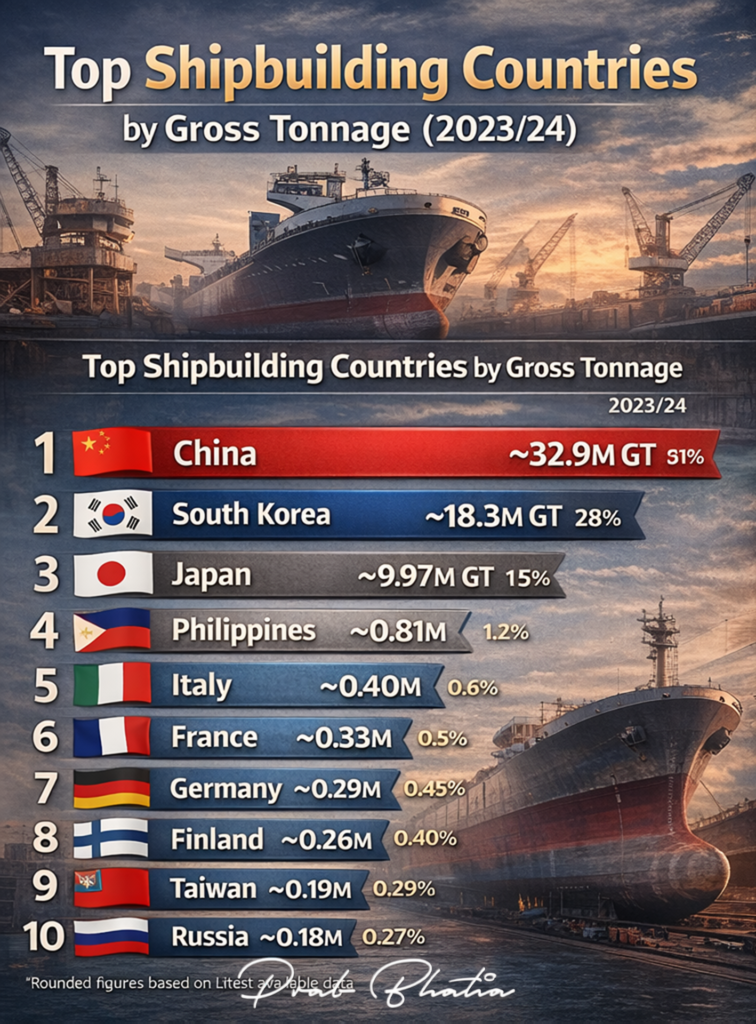
Ironically, none of the above three countries’ populations could speak English. And despite all the shipbuilding ingredients India had, India stands nowhere in the top shipbuilding or ship owning countries in the world.
If Japan’s ascent was built on discipline, Korea’s on determination, and China’s on sheer audacity, then India’s story is one of watching from the sidelines. At the very moment when Asia’s shipbuilding revolution was reshaping the global seas, India—with its centuries-old maritime traditions and engineering talent—chose not to climb.
India inherited not only British-built shipyards but also a vibrant tradition of coastal craft building, a skilled workforce, and a manufacturing base that pre‑dated many Asian nations. It had the manpower, the raw material, and the geopolitical need. By 1947, the foundations of a serious maritime economy were already in place.
Yet instead of building on these assets—as Japan did with American technology, or China with Japanese and European know-how—India turned away from them. In the heat of the independence struggle, a damaging narrative took hold: that everything industrial or mechanical built under colonial rule was somehow contaminated. The British were blamed for “stealing 30–40 trillion,” while the more uncomfortable truth was ignored—that India already had the tools, the workshops, and the engineers, but lacked the will to continue the journey.
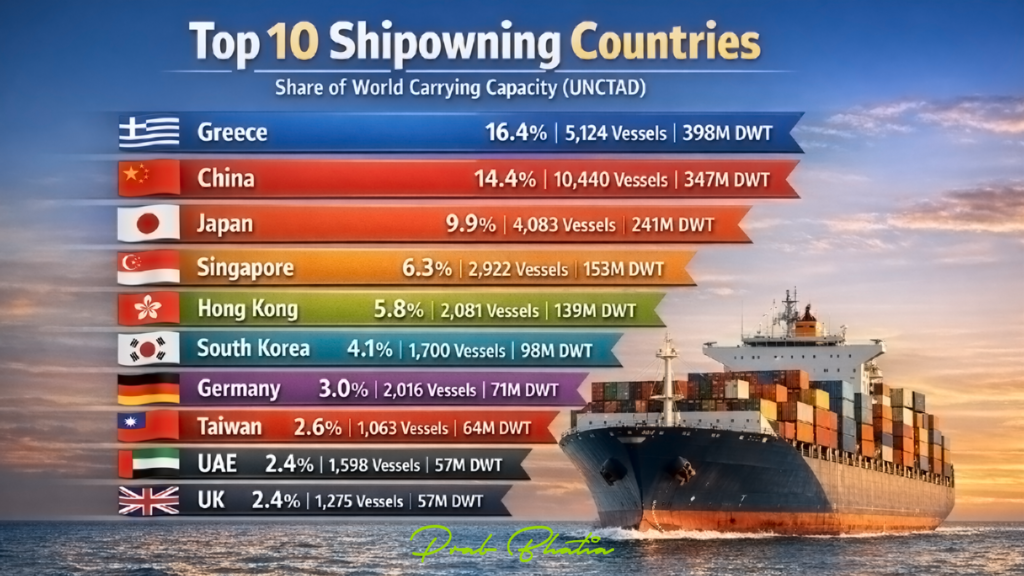
Japan did not discard what the West taught it. China did not resent foreign technology; it absorbed and surpassed it. Korea did not dwell on history; it bent steel until the world took notice.
India, meanwhile, circulated ever‑embellished stories of a 5,000-year-old golden age, narratives that grew louder even as its industrial momentum faded, and became entangled in bureaucracy, overregulation, and a complacent belief that the world would somehow wait. Instead of upgrading British-era shipyards into global manufacturing hubs, India allowed them to stagnate. Instead of scaling locomotive and marine engineering capability, it normalised import dependence—even for basic items like railway wagon wheels.
India did not leap forward like China, nor refine itself like Japan and Korea. Instead, it marked time—content to repair and refit in trivial numbers, and build a trickle of naval vessels, while commercial shipbuilding opportunities slipped away to its neighbours.
This is not the story of ambition cut short, but of ambition never attempted.
THE COST OF A MISSED INDUSTRIAL REVOLUTION
Had India chosen a different path—one that nurtured private shipyards, encouraged foreign collaboration, promoted talent, and built clusters along the coast—the country could have:
- saved billions in foreign exchange
- created millions of skilled jobs
- become a major exporter of ships and marine equipment
- built a deep reservoir of technical know-how
- strengthened its naval and commercial maritime capabilities
Instead, India became a maritime labour superpower, not a maritime manufacturing superpower.
WHAT INDIA COULD HAVE BEEN—A DATA-DRIVEN PROJECTION
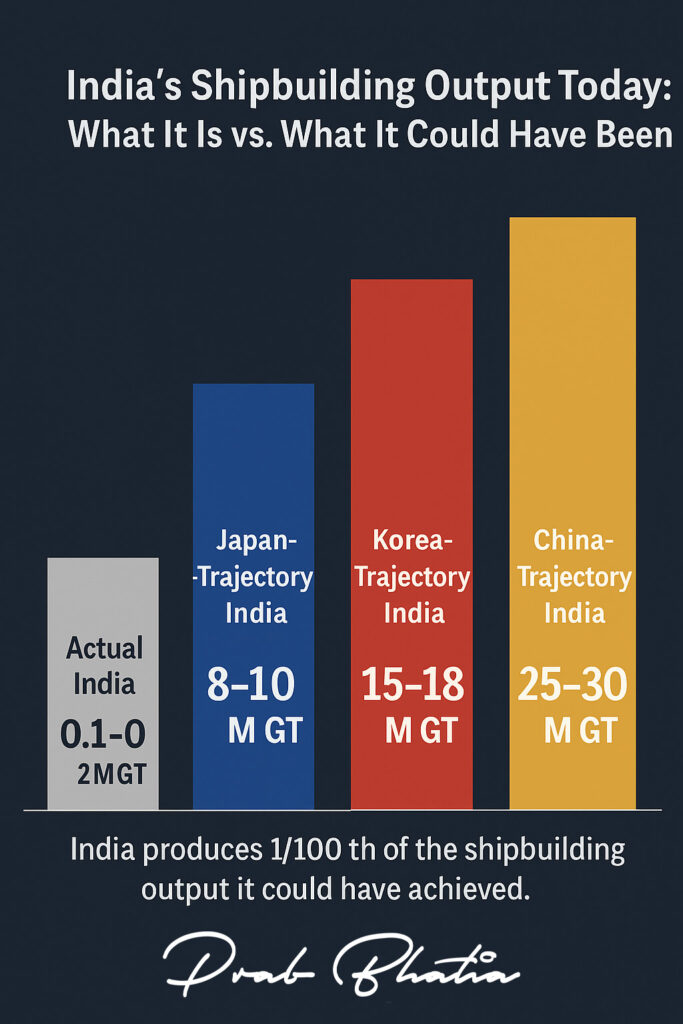
To understand the scale of India’s missed opportunity, we can model India’s potential shipbuilding output today using the historical growth curves of Japan, South Korea, and China. All three nations began with less than India had in 1947 — yet all three became global shipbuilding giants.
If India had followed:
- Japan’s trajectory: India would be producing 8–10 million GT today.
- South Korea’s trajectory: India would be producing 15–18 million GT today.
- China’s trajectory: India would be producing 25–30 million GT today.
Actual output today: ≈ 0.1–0.2 million GT (less than 0.1% of global share)
India is producing 1/100th of what it could have produced.
This is not speculation—it is a counterfactual grounded in real industrial growth patterns. It shows, with painful clarity, how a nation that once built ships for the British Navy now imports ships, sends vessels abroad for repairs, and buys even basic marine spares from overseas.
And yet — the potential remains.
CAN INDIA BE THE NEXT MELTING POT OF SHIPBUILDING?
For decades, India stood at the water’s edge, watching other nations build the ships that carried the world. But something shifted in 2014. Within months of taking office, Prime Minister Narendra Modi made a quiet but significant detour during his visit to South Korea: a stop at Hyundai Heavy Industries. The message was unmistakable—India wanted to build LNG carriers, and it wanted Korean expertise to make it happen.
Behind the scenes, the push had already begun. Pipavav Shipyard, nudged into tying up with a reluctant GAIL, suddenly found itself on the cusp of a historic partnership. The possibility of building India’s first LNG carriers on Indian soil triggered a corporate chain reaction: Reliance swooped in and acquired the yard. But when the Korean partnership faltered, the dream dissolved, and the yard eventually passed from Reliance to Swan. It was a moment that revealed both India’s hunger and its fragility—a country ready to leap, but still learning how to land.
Yet the story did not end there.
If the first attempt was a stumble, the years that followed have been a slow, deliberate rising. India began to recognise the cost of its shipbuilding vacuum—the billions spent on foreign vessels, the lost jobs, the missed industrial ecosystems. And for the first time in decades, the nation responded not with slogans, but with strategy.
Today, the landscape looks very different.
India has identified South Korea as a strategic partner in its drive to scale up shipbuilding capacity. The government has set its sights on entering the world’s top ten shipbuilding nations by 2030, and the top five by 2047. This isn’t rhetoric; it’s backed by billions in planned investment, new dry docks, and a national fleet expansion from 1,500 to 2,500.
Most importantly, the Korean partnership that once slipped away has returned—this time with deeper roots.
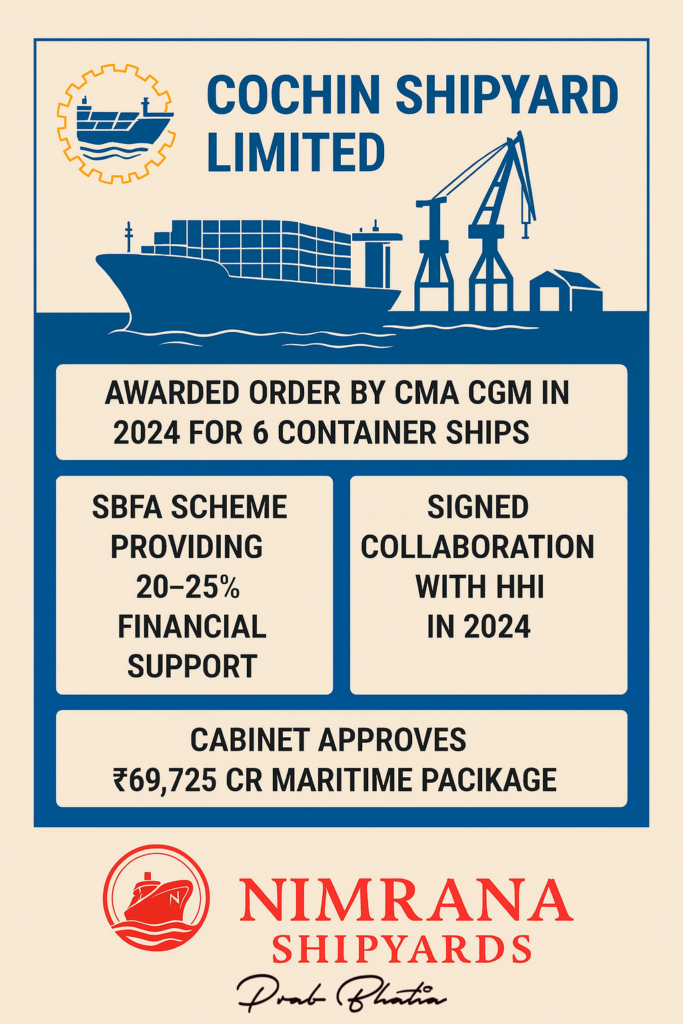
In 2024–25, HD Hyundai and Cochin Shipyard Ltd. signed a landmark agreement to collaborate across the shipbuilding value chain. This is not a ceremonial handshake. It includes:
- joint design and procurement,
- productivity and quality enhancement,
- workforce training,
- and a long-term plan to bid together for global shipbuilding orders.
Cochin Shipyard’s new 310‑metre dry dock—capable of handling large commercial vessels—is now being paired with Korean technical leadership. There is even a proposed ₹100‑billion joint venture yard in Thoothukudi, aimed at building VLCCs and high-tonnage ships.
For Korea, this partnership offers scale and cost efficiency. For India, it offers something far more valuable: a second chance.
A chance to absorb technology the way Japan once absorbed American know-how. A chance to build high-value vessels like LNG carriers at competitive prices. A chance to finally turn its coastline, workforce, and maritime heritage into industrial power.
India is no longer merely watching. It is learning, aligning, and—cautiously but unmistakably — accelerating.
India’s shipbuilding revival will not happen in isolation. Korea remains the most natural partner—a nation whose shipyards shaped the modern maritime world and whose production discipline, design maturity, and industrial culture offer India a living blueprint. But Korea will not be the only collaborator in the years ahead.
Once India opens its doors with clarity, consistency, and conviction, the world’s major shipbuilding nations will see opportunity on our shores. Other Korean yards will look to India as the logical extension of their capacity. Japanese shipbuilders — masters of precision engineering and lean production — will find in India the scale and demographic depth they no longer possess at home. American yards, stretched by defence demand and labour shortages, will seek trusted Indo-Pacific partners capable of absorbing overflow and co-developing next-generation naval platforms. European yards, leaders in green propulsion, cruise technology, and specialised vessels, will look to India’s cost competitiveness and engineering talent to remain globally viable.
And even Chinese yards—now increasingly aligned with India through BRICS and the broader Global South realignment—may find room for collaboration in specialised, non-strategic segments where joint ventures benefit both sides. Geopolitics will shape the boundaries, but industrial logic will shape the opportunities.
Because once India signals seriousness—once the ecosystem, the land, the financing, and the governance align—every major shipbuilding nation will want a stake in its rise. That is what a melting pot truly is: not a single partnership, but a convergence of ideas, capabilities, and ambitions from across the world.
The question is no longer “Can India build ships?” It is “Can India build an ecosystem?”
THE FINAL CRESCENDO: A FUTURE WORTH BUILDING
For seventy years, India stood beside the ocean with its hands in its pockets, watching other nations build the ships that shaped the world. But the tide is turning. The question now is not whether India can build ships—it is whether India can build the ecosystem, the greenfield shipyards, shipbuilding cities, the clusters, the culture, and the courage required to sustain a shipbuilding nation.
And that future will not be built by balance sheets alone.
Shipbuilding is not a quick-profit industry. It is not a quarterly results industry. It is not an industry for those who chase valuations and exit strategies. Shipbuilding belongs to a different tribe—to those who dream ships, breathe ships, and are willing to devote their lives to steel, sweat, seawater, and the long arc of industrial creation.
If India is to rise again on the global maritime stage, it must nurture this tribe.
It must create space for young marine engineers and naval architects who burn with the same passion that once built Bombay Dockyard, Garden Reach, and Visakhapatnam.
It must protect them from being swallowed by conglomerates that see shipyards as assets to flip rather than legacies to build.
It must give them the confidence that a life spent designing hulls, engines, and yards is not a detour, but a national calling.
For this, the government’s role is not optional—it is foundational.
India needs single‑window clearances that actually clear.
It needs certification processes that assist and enable, not obstruct.
It needs departments that help projects take off, not bury them in files.
It needs coastal land allocated with vision, not hesitation.
It needs long‑tenure, low-interest financing that understands the rhythm of shipbuilding—a rhythm measured not in months, but in decades.
Most of all, India needs to believe in its own builders again.
Because shipyards are not just factories. They are civilisational statements.
They say: we build; therefore, we belong.
They say: we are not passengers in the world economy; we are navigators.
They say: we are not a nation that watches—we are a nation that shapes.
I have spent a lifetime in this industry—in shipyards, in design rooms, in boardrooms, in dry docks, in the quiet hours before launch when a vessel stands like a sleeping giant waiting for her first taste of water. I have seen what India can do when it chooses to. I have seen what we lose when we hesitate. And I have seen, in recent years, the first sparks of a long-overdue awakening.
India has a second chance. Nations rarely get one. We must not waste it.
If we nurture talent, dismantle bureaucracy, empower dreamers, and build partnerships rooted in learning rather than pride, India can become not just a participant in global shipbuilding—but a melting pot, a crucible, a forge where new ideas, new designs, and new generations of shipbuilders are born.
The ocean has waited long enough. Now it is India’s turn to build.
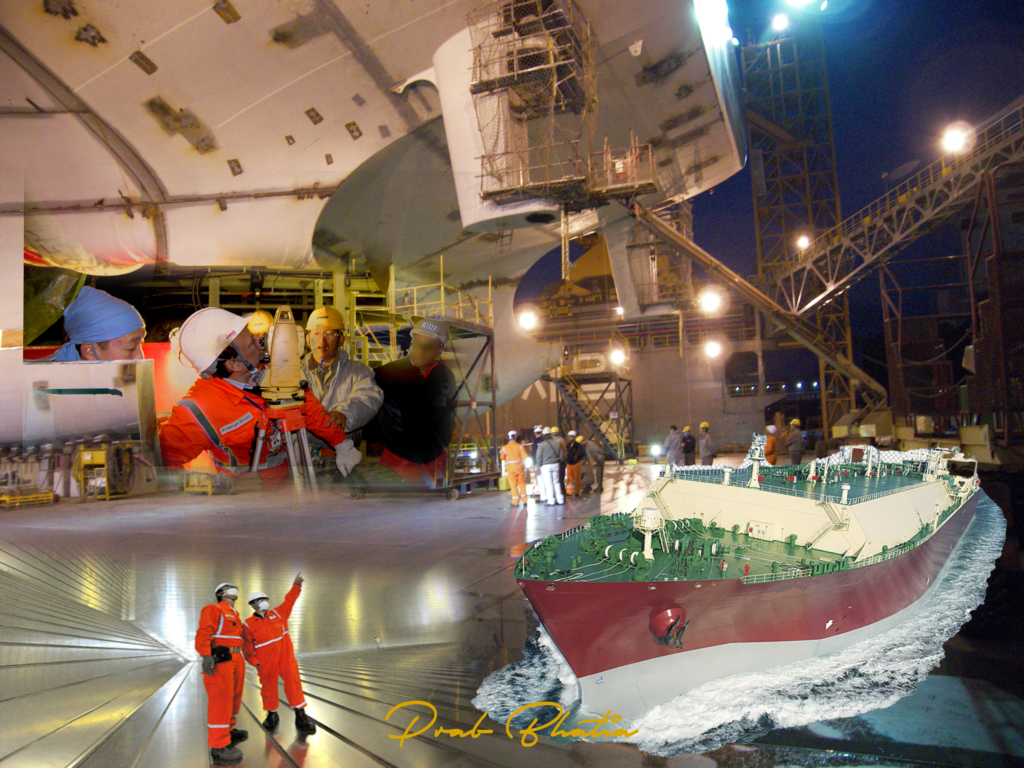
In the end, this series is not just about shipyards or steel or policy. It is about a country learning to remember what it once knew, and a man who spent a lifetime watching its tides rise and fall. I have walked through empty docks at dawn, stood beneath hulls that felt like sleeping mountains, and seen young engineers stare at blueprints with the same wonder I once carried. And I know this: nations are not built by governments alone, nor by capital alone, but by people who choose to give their lives to something larger than themselves. If India can find the courage to trust its builders, to clear the path for its dreamers, and to believe again in the long, patient art of shipbuilding, then the future will not belong to those who overtook us—it will belong to those who refused to stop imagining.
The ocean is still waiting.
And so am I.
And so, five decades after that first calm morning at sea, the horizon remains wide—not as a memory, but as an invitation. India can still reclaim its maritime destiny. The engines are steady once more; it is time to set a new course.
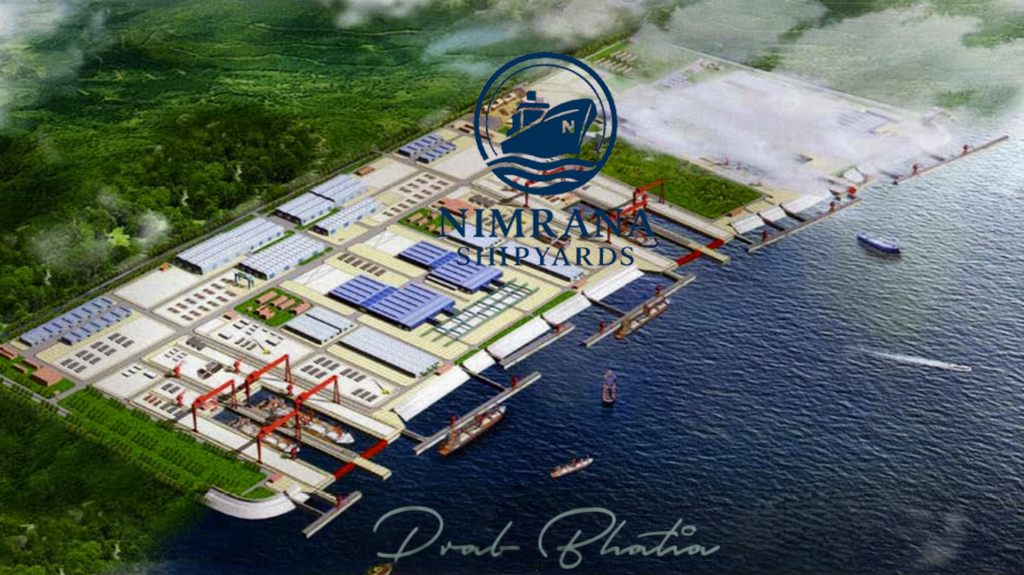
“For all the years I have given to the sea, shore and shipyards, I still believe India’s greatest ships are yet to be built.”