

WHY U.S.–KOREA SHIPBUILDING MATTERS NOW
Shipbuilding has always been more than steel and rivets. It is about national security, industrial might, and the ability to shape global tides. From the Liberty ships of World War II to the LNG carriers of today, the story of who builds the world’s ships is also the story of who commands the seas.
Today, as great power competition reshapes the oceans, the United States and South Korea are poised to forge a new era of maritime cooperation—one that could redefine not only the future of shipbuilding, but the balance of power at sea.
A WORLD AT SEA CHANGE
During World War II, U.S. shipyards produced more than 5,000 vessels in just four years. It was an unmatched feat of industrial scale, turning the tide of history and proving that industrial capacity was as decisive as battlefield courage.
But since then, America’s once-dominant commercial shipbuilding industry has withered. The U.S. Navy today relies on a handful of overstretched yards, while commercial shipbuilding has almost entirely disappeared from American shores.
Contrast this with Asia:
- Japan and South Korea became global leaders in the late 20th century.
- China now outpaces them both, producing more warships and commercial tonnage annually than any other nation in history.
The strategic consequence is stark: the U.S. has unmatched naval experience and technology, but it lacks the industrial depth to sustain maritime dominance on its own.
WHY KOREA? WHY NOW?
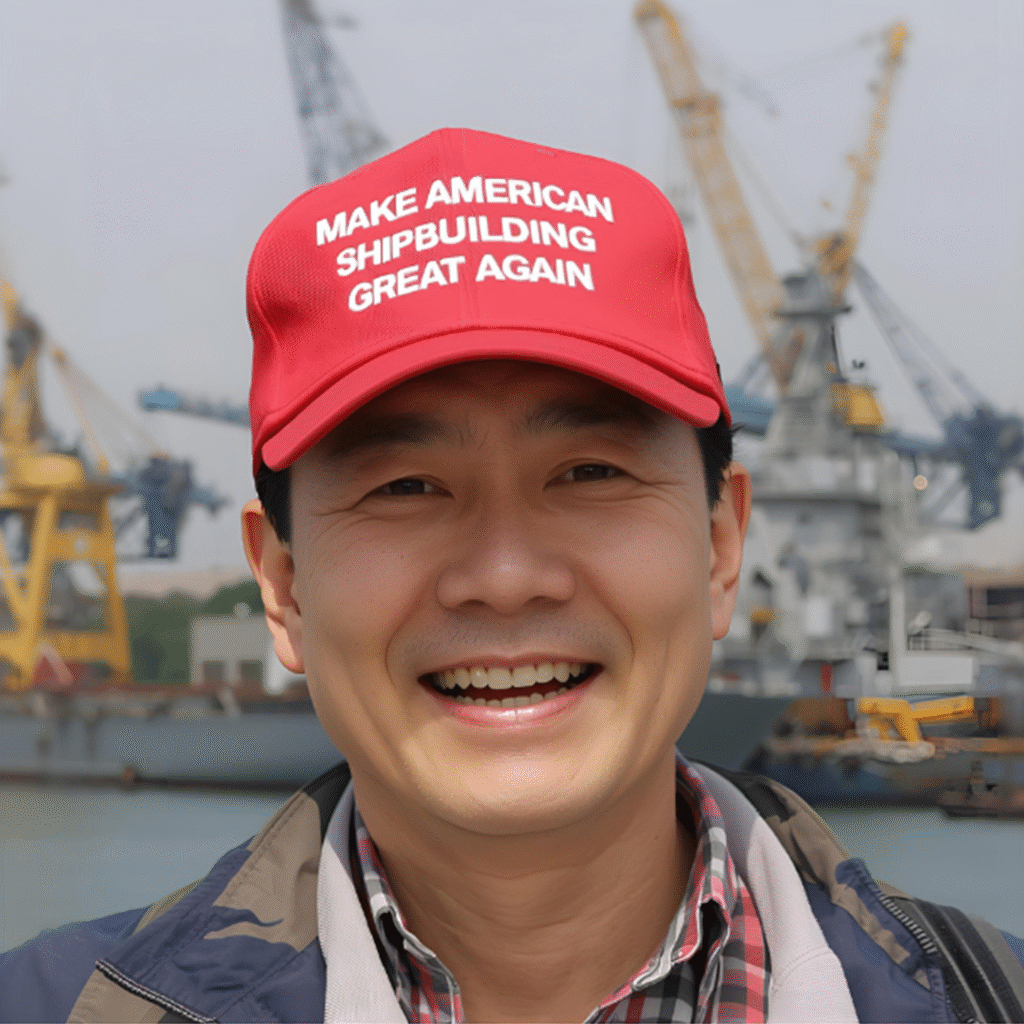
South Korea brings something unique to the table (and it’s not to make American Shipbuilding Great Again):
- Scale and efficiency from yards like HD Hyundai, Samsung Heavy, and Hanwha Ocean.
- Global credibility in LNG carriers, tankers, and advanced naval platforms.
- A proven ability to deliver on time and at cost in one of the most complex industries in the world.
At the same time, Washington is looking for ways to revitalise domestic capacity without reinventing the wheel. Partnerships with Korean firms—investing directly in U.S. yards—may offer a bridge: strengthening America’s defence base while creating jobs and skills at home.
The recent Hanwha–Philly Shipyard deal is only the opening chapter. More alliances will follow. The stakes are enormous.
WHAT THIS BLOG WILL DO
This site will track, explain, and analyse this transformation. You’ll find here:
- Breaking news on deals, contracts, and investments.
- Deep dives into the history and future of U.S. shipbuilding.
- Global competition analysis: how America, Korea, Japan, China, and India are shaping the seas.
- Deal trackers and data to follow the money behind the headlines.
WHY YOU SHOULD FOLLOW
Because the ability to build ships will define the 21st-century balance of power.
Can America rebuild its industrial base? Will Korea’s investment strategy reshape the U.S. maritime landscape? How will China respond to a U.S.–Korea alliance? These are not abstract questions. They touch the future of trade, security, and the world order itself.
The story of U.S.–Korea shipbuilding is only beginning—and it may decide whether America sails confidently into a new century of maritime leadership, or drifts into dependence.
Stay tuned. The tide is turning.
PS, very good and detailed blog.
Please also talk about Indian initiatives in Shipbuilding. Modi talked about some joint ventures with Japan during his recent visit.
Thanks for reading the blog, Rajan.
I will be covering India in the second act.
Act I: America’s struggle and Korea’s role (6 blogs)
Act II: India stepping into the conversation with Japan/Korea. And then some more.
Greatly appreciate your encouragement. Thanks again!
Hi PS….I read all your blogs and find them informative and interesting but this is the first time I’m commenting. Keep on writing.
Hi Naresh… Thank you so much! It means a lot that you’ve been reading and chose to leave your first comment—I truly appreciate the encouragement. There’s more to come, so I hope you’ll keep reading and sharing your thoughts.
Hi Prabh, I am looking forward to your reporting on the revival in the US shipbuilding industry. I live in the US and have worked all my working life (since 1972) in the shipbuilding/shipping industries. Lately (since 2007) I did not follow the developments, but I am sceptical that a revival is possible in the next 20-30 years. The industrial base, the know-how and the work force did erode in the last 30 years. In 2024 US built only 10 commercial ships (they most likely cost 3x as much as Chinese built ships) and I doubt they would have been built here if it was not of the Jones Act. I hope to be proven wrong.
Jay
Hi Jay, Thank you for sharing your perspective — and especially for bringing decades of firsthand experience in shipbuilding to this discussion. You’re right: the erosion of America’s industrial base, know-how, and workforce over the past 30 years is a central challenge. The numbers speak for themselves — with U.S. output a fraction of China’s and costs often two to three times higher. Without Jones Act protection, commercial newbuildings would have probably stopped.
That scepticism is exactly why I’m writing this series. The goal isn’t to paint an easy or romantic picture but to weigh whether the new investments, alliances (especially with South Korea), and geopolitical pressures can realistically bend the curve. Revival won’t be quick — and certainly not on the scale of WWII’s 5,000-ship miracle — but there may be pathways where strategic necessity, technology transfer, and industrial partnerships create footholds for renewal.
I hope you’ll keep following along and challenge my assumptions. Healthy scepticism from people who’ve lived in this industry is the best way to keep the conversation honest. And if revival does come, it will be because these hard realities are confronted, not ignored.