

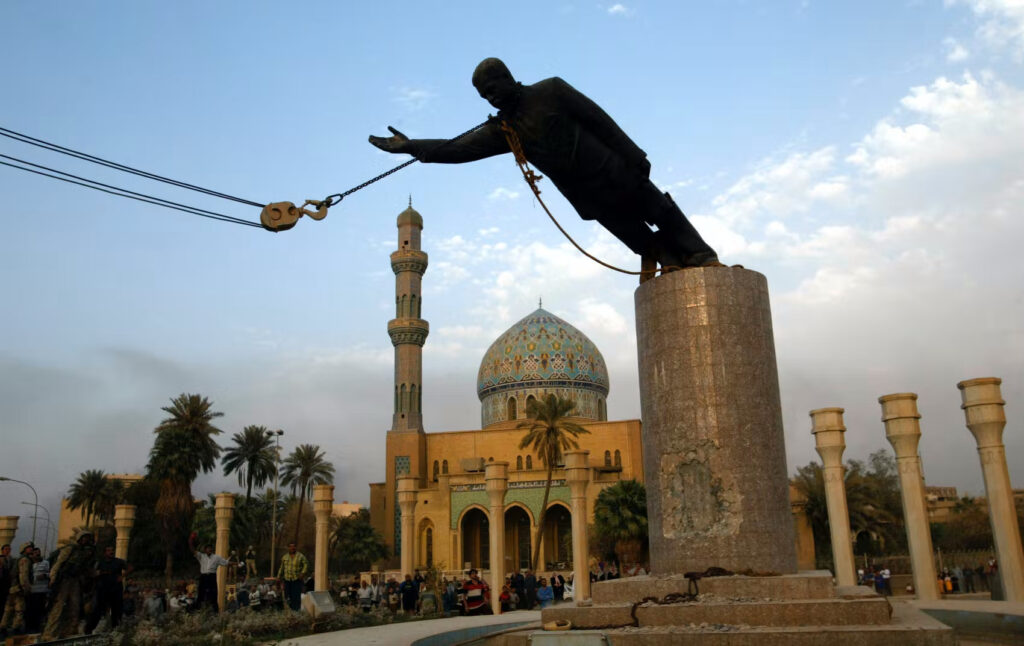
There are distinct patterns and strategies that major powers—especially the U.S., UK, and NATO allies—have used to engineer regime change in various countries. These interventions often follow a formula that includes political, economic, military, and covert tactics.
Regime Change Formula: Key Steps & Patterns
1. Demonization of the Target Regime (Propaganda & Narrative Building)
- Before any regime change, the leader is portrayed as a tyrant, dictator, or human rights violator.
- Media campaigns highlight atrocities, corruption, and repression.
- The “Hitler comparison” is frequently used to justify intervention.
Examples:
- Iraq (2003) – Saddam Hussein was accused of having Weapons of Mass Destruction (WMDs).
- Libya (2011) – Gaddafi was framed as a “butcher killing his own people.”
- Venezuela (2019-Present) – Nicolás Maduro labelled as an illegitimate dictator.
- Syria (2011-Present) – Bashar al-Assad accused of chemical weapons attacks.
2. Economic Sanctions & Isolation
- The target country is crippled with sanctions, causing inflation, unemployment, and social unrest.
- Access to global banking systems (SWIFT) is cut, blocking financial transactions.
- U.S. and Western allies freeze assets of government officials.
Examples:
- Iran (1979-Present) – Decades of U.S. sanctions to weaken the regime.
- Cuba (1960-Present) – Economic embargo to isolate the government.
- Venezuela (2015-Present) – Sanctions crushed the economy, worsening poverty.
3. Supporting Opposition & Protests (Colour Revolutions)
- Western-backed NGOs, think tanks, and media outlets fuel anti-government sentiment.
- Protests are encouraged, often escalating into violent uprisings.
- Social media campaigns and foreign-funded activists play a key role.
- If the leader refuses to step down, civil war or military coups are supported.
Examples:
- Ukraine (2014, Euromaidan Revolution) – U.S. backed Neo-Nazi protesters against Russia-friendly President Yanukovych.
- Georgia (2003, Rose Revolution) – Western-funded activists ousted pro-Russian President Shevardnadze.
- Egypt (2011, Arab Spring) – U.S. supported mass protests against Hosni Mubarak.
4. Military Intervention (If Soft Power Fails)
- When economic sanctions and protests fail, direct military action follows.
- Often starts with no-fly zones, airstrikes, and “humanitarian interventions.”
- Proxy forces (rebels, militias) are armed and trained.
- The leader is overthrown or assassinated.
Examples:
- Iraq (2003) – U.S. invasion toppled Saddam Hussein.
- Libya (2011) – NATO airstrikes led to Gaddafi’s brutal execution.
- Afghanistan (2001) – U.S. military removed the Taliban.
- Syria (Failed, 2011-Present) – U.S. armed rebels, but Assad survived.
5. Installing a Puppet Government
- A pro-Western leader or government is installed.
- The new government is financially dependent on Western aid.
- Resources, especially oil, gas, and minerals, are controlled by foreign corporations.
Examples:
- Iraq (2003-Present) – U.S. installed a new government, but the country remains unstable.
- Afghanistan (2001-2021) – U.S.-backed government collapsed as soon as U.S. troops withdrew.
- Ukraine (2014-Present) – Pro-Western government installed after the 2014 coup.
6. Long-Term Military Presence or Chaos (Control Through Instability)
- Permanent U.S. military bases are established in the country.
- If the new government is weak, the country is left in chaos, making it dependent on Western intervention.
- Even if regime change is not fully successful, civil war and division weaken the country.
Examples:
- Iraq – U.S. military bases remain.
- Syria – U.S. troops occupy oil-rich areas.
- Libya – Since Gaddafi’s fall, Libya has been in permanent civil war.
Regime Change Pattern: Key Observations
- Wars are often about resources (oil, gas, strategic location).
- Justifications change, but the process remains the same:
- 1950s–1980s: Anti-Communism (Cold War)
- 1990s–2000s: Human Rights & Democracy
- 2010s–Present: War on Terror & “Threats to Democracy”
- Countries outside U.S. influence are always targets (Iraq, Libya, Syria, Venezuela, Russia, China).
Modern & Ongoing Regime Change Efforts
- Venezuela (2019-Present) – U.S. attempted to install opposition leader Juan Guaidó.
- Belarus (2020-Present) – Western-backed protests against President Lukashenko.
- Russia (Ongoing) – U.S. supports opposition figures like Alexei Navalny.
- China (Future?) – U.S. supports separatist movements in Hong Kong, Taiwan, and Tibet.
Conclusion
The regime change playbook follows a predictable pattern:
- Demonize the leader (media narratives).
- Sanctions and economic warfare.
- Support internal opposition (protests, rebellions).
- If needed, military intervention.
- Install a pro-Western leader.
- Maintain military presence or create long-term instability.