

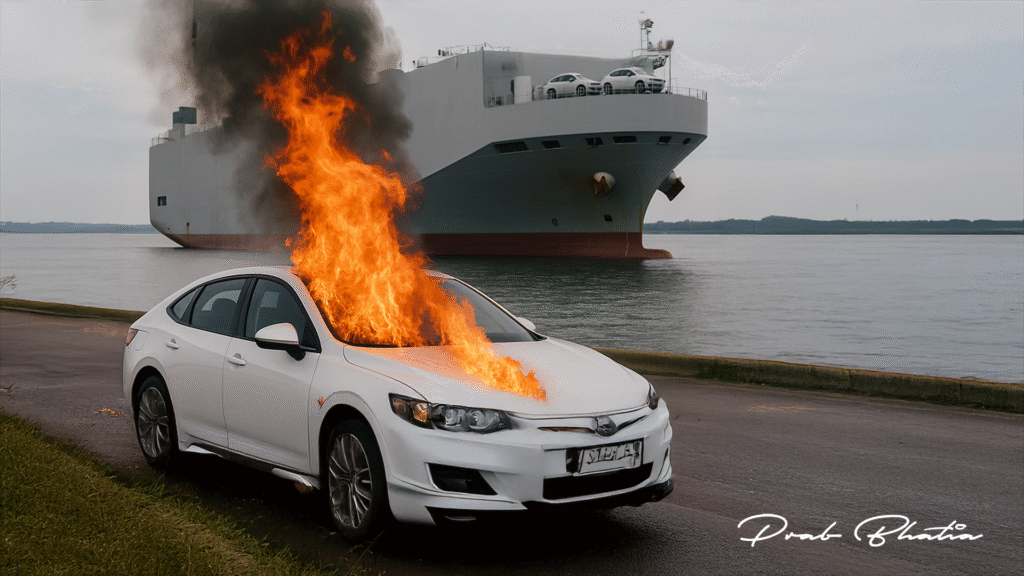
In the early hours of a grey Alaskan morning, plumes of black smoke billowed from the deck of the Morning Midas, a Liberian-flagged car carrier operated by Zodiac Maritime and ultimately owned by Shanghai Auto. The vessel was en route from Yantai, China, to Lázaro Cárdenas, Mexico, transporting approximately 3,000 vehicles—including around 800 electric and hybrid cars. The crew had abandoned ship, leaving it adrift and ablaze in the Gulf of Alaska. The suspected cause: a fire believed to have started in the battery compartment of one of the electric vehicles stowed below deck. It wouldn’t be the first time such an incident made headlines—and, worryingly, it likely won’t be the last.
Electric vehicles (EVs), long hailed as the saviours of a carbon-choked planet, have ushered in a global industrial transformation. Governments incentivize their adoption, and legacy automakers alongside ambitious startups have pledged all-electric lineups. Yet, amid this race toward decarbonization, one critical question smoulders beneath the surface: Are we overlooking the safety risks—especially the fire hazards—that EVs pose, particularly when stored or transported in large numbers?
A New Kind of Fire
Unlike internal combustion engine (ICE) vehicles, which primarily burn from fuel leaks, EVs burn from within. At the heart of every electric vehicle lies a lithium-ion battery—an energy-dense powerhouse designed for performance but inherently prone to thermal runaway. When damaged, overcharged, or poorly manufactured, these batteries can ignite in a matter of seconds, releasing intense heat, toxic gases, and even explosions.
Once ablaze, such fires are difficult to extinguish using conventional firefighting methods. Water can slow them, but may not stop them. Special chemicals, blankets, or submersion tanks are often required—none of which are routinely available aboard maritime cargo carriers.
Fires at Sea: A Pattern Emerges
The Morning Midas is just one in a string of similar incidents. In 2023, the Fremantle Highway, a vehicle carrier off the Dutch coast, caught fire while carrying nearly 500 EVs. The blaze raged for days, resulting in the death of one crew member and drawing international attention. A year earlier, the Felicity Ace, another car carrier, sank after a battery fire burned unchecked aboard a cargo of Porsches and Bentleys.
In each of these cases, the design of maritime transport vessels proved inadequate. These ships, built in an earlier era, were never designed to carry high-risk chemical batteries. Fire suppression systems—fine for conventional cars—often fail catastrophically when dealing with lithium-ion events. The closed-deck nature of car carriers, coupled with the sheer density of vehicles loaded side by side, creates a perfect storm where one ignition can cascade into mass destruction.
Electric Vehicle Fire Risks: What the Data Shows
While electric vehicles (EVs) are often portrayed as inherently volatile, a closer look at the data reveals a more nuanced picture. According to AutoinsuranceEZ, internal combustion engine (ICE) vehicles actually have a higher fire incidence than EVs:
Vehicle Type | Fires per 100,000 Sold |
Internal Combustion | 1,530 |
Hybrid | 3,475 |
Electric Vehicles | 25 |
However, severity, not frequency, is the crux of concern. Fires in EVs—especially those caused by thermal runaway in lithium-ion batteries—are notoriously hard to extinguish, requiring specialized suppression methods, enormous water volume, or complete containment. They burn hotter and longer than petrol fires and may reignite hours or days later.
The main causes of EV fires include:
- Manufacturing defects (battery/module assembly)
- Impact or puncture in crashes
- Faulty or improperly installed charging equipment
- Overcharging or thermal management system failure
Maritime Incidents: A Rising Threat
The risk multiplies at sea. The 2023 Fremantle Highway fire, caused by a suspected EV on board, killed one crew member and triggered a multi-day blaze. Similarly, the 2024 fire aboard Morning Midas, off the Alaskan coast, is believed to involve an EV. These incidents highlight the incompatibility between existing shipboard fire suppression systems and battery fires.
Cargo ships carrying hundreds—or thousands—of EVs may become floating tinderboxes if one cell ignites. Despite this, global maritime regulations haven’t kept pace. Many carriers still lack designated EV zones, thermal imaging systems, or firebreak compartments tailored to lithium-based cargo.
Why Do Electric Vehicles Catch Fire?
1. Lithium-Ion Battery Chemistry
- EVs use high energy-density lithium-ion batteries.
- These batteries are prone to thermal runaway—a feedback loop of rising temperature, pressure, and chemical reaction that can result in explosions or fires.
Once ignited, lithium battery fires are extremely difficult to extinguish, especially in enclosed or remote spaces (like ship decks or cargo containers).
2. Mechanical or Manufacturing Defects
- Microscopic manufacturing flaws (e.g., dendrite formation, metal contamination) can cause internal short circuits.
- Poorly managed battery management systems (BMS) or faulty sensors can fail to detect or mitigate the risk in time.
3. Damage and Stress
- Crashes, improper handling, overcharging, or exposure to heat/moisture can damage batteries and increase fire risk.
- Stacked shipping conditions, vibrations at sea, or residual charging can increase vulnerability in transit.
4. Delayed Ignition
- EV fires can occur days or even weeks after damage, making them unpredictable. This is especially dangerous on cargo ships or in garages.
Regulatory Blind Spots & Challenges
Despite new safety regulations:
- Global standards are still catching up. EV fire safety codes (UN ECE R100, ISO 6469, etc.) are not uniformly enforced or implemented, especially for marine transport.
- Shipboard firefighting systems are not designed to handle lithium fires. CO₂ or water mist systems may be ineffective or even dangerous.
- Lack of transparency from manufacturers about the flammability or stability of battery chemistries used.
- No global maritime protocols yet fully account for EV-specific fire risks in car carriers or RoRo vessels.
Are We Chasing the Wrong Dream?
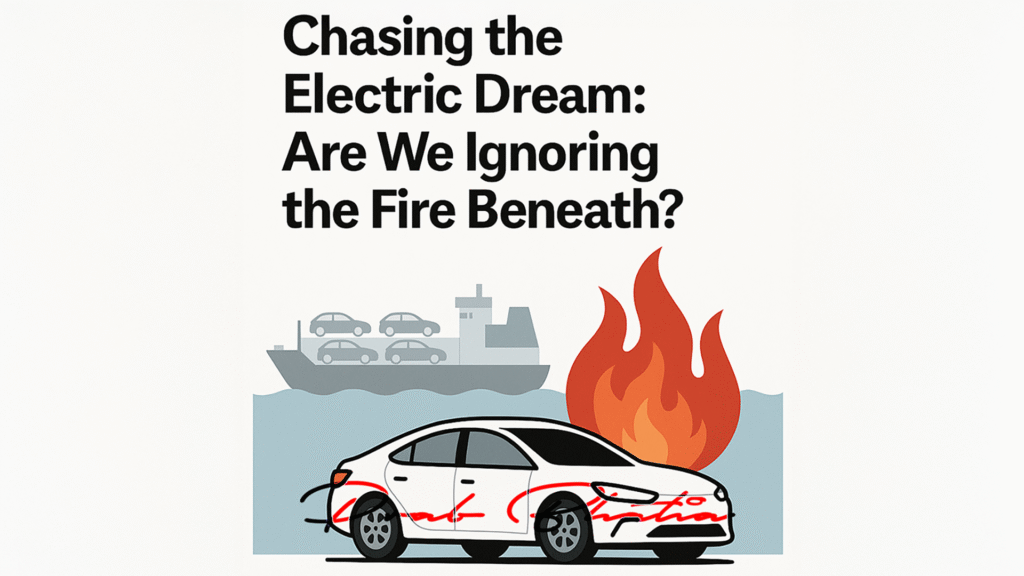
We are not necessarily chasing the wrong dream—but perhaps we are chasing it too quickly, too blindly. The electric vehicle revolution must be more than a political slogan or a market-driven trend; it must be a durable, secure, and ethically grounded transformation. Otherwise, we risk replacing one form of unsustainability with another—cleaner in appearance, but still smouldering beneath the surface.
The Environmental Paradox: While EVs produce no emissions at the tailpipe, their supply chains—especially for lithium, cobalt, and nickel—raise serious environmental and ethical concerns. Mining operations are often resource-intensive, ecologically destructive, and tied to exploitative labour practices.
Safety and Infrastructure Gaps: Fire risks aren’t mere technical footnotes; they are real, recurring, and frequently underreported. From underground parking garages to transoceanic car carriers, many cities and maritime routes remain unprepared for EV-specific fire hazards.
Economic Fragility: A single shipboard fire can destroy thousands of vehicles, disrupt global supply chains, and trigger insurance and environmental fallout. These incidents raise uncomfortable questions about whether global logistics systems are truly ready for mass EV adoption.
This isn’t a call to abandon electrification—far from it. EVs are essential to phasing out fossil fuels and reducing urban pollution. But like all emerging technologies, their risks must be addressed with urgency and transparency. In our race to meet climate goals and consumer demand, we’ve too often ignored a basic question: Are our infrastructure and regulatory frameworks truly prepared for the scale of what’s coming?
Aviation faced similar growing pains. The early jet age was riddled with accidents until materials science, safety protocols, and training caught up. The same evolution must now take place for electric vehicles—on roads, in garages, in public charging spaces, and critically, at sea.
EVs offer undeniable benefits: reduced emissions, lower urban air pollution, and high energy efficiency. When powered by renewable sources, they chart a compelling course toward sustainable mobility.
Yet that optimism must be tempered by a sober assessment of the hidden costs.
Toward a Smarter Transition
The solution is not to abandon EVs but to pursue their deployment with greater caution, investment in safer battery technologies (such as solid-state or sodium-ion), and updated safety regulations for every step of the EV lifecycle—from mine to motor to maritime hold.
Governments must enforce EV-specific maritime safety codes. Automakers should disclose battery fire data and support emergency services with transparent risk documentation. Salvage tugs, port authorities, and even insurance firms need new operating procedures for the unique hazards posed by electric cargo.
Conclusion: A Smarter Future is a Safer One
If the EV revolution is to succeed, it must be built not just on innovation and intention, but also on integrity, regulation, and realism. We need:
- Global standards for EV fire suppression on ships
- New vessel designs with fire-isolated decks
- Mandatory battery safety testing for shipping
- Emergency protocols and crew training tailored for battery fires
The Morning Midas is a warning—not against EVs, but against blind acceleration. We must not let our green ambitions go up in smoke.
- Prabhjot S Bhatia is a maritime expert and writer based in London. He is the Director of Nimrana Marine Consultancy Ltd. and founder of Nimrana Media.
For reprints or collaboration, contact info@nimrana.com
Similar fires we have seen in India where the transporting vehicle carrying electric two wheelers (lithium ion batteries) suddenly catch fire and the entire cargo, is gutted.
Absolutely, Inder. There have been so many cases of electric cars and scooters catching fires for no apparent reason even in the U.K., even standing idle in the garage. One must be cautious until better and safe products become available.
Well written article on EV, the hazards of lithium ion batteries.
Looking forward to alternative batteries , sodium ion batteries and solid state batteries to replace lithium ion batteries.
Cheers PSB
Plenty of research going on around the world and hopefully, we’ll be see better and safer products in the market. Thanks for sharing your thoughts.
Thanks Prab for shedding more light on the safety of EVs. I learned few things that escape the general public. The whole EV craze is hard to justify economically or environmentally. I undestand Norway going fully electric where 95% of power is generated from renewable resources. But the rest of the world???
Really appreciate your comment, Jay. It echoes what a lot of people are quietly thinking but not often saying out loud. EVs are often sold as a silver bullet, but when you look closer, the picture gets a lot more complicated. Like you mentioned, Norway makes sense—nearly all their electricity is renewable, and their population is relatively small. But trying to apply that same model everywhere else, especially in countries where coal and gas still dominate the grid, raises real questions.
There’s also the issue of how EVs are made. Mining for lithium, cobalt, and nickel isn’t exactly clean or conflict-free, and those massive batteries don’t recycle easily. In some cases, the carbon footprint just shifts from tailpipe emissions to emissions at the power plant or mine.
And economically? For many people, especially in developing countries, EVs are still way out of reach. So while they might work well in wealthier nations with clean grids and government subsidies, for the rest of the world, the rush to electrify feels premature—if not a little tone-deaf.
None of this is to say EVs are a bad idea. But as you rightly point out, without clean energy and fair global supply chains, they’re not the climate fix they’re often portrayed to be. What we probably need is a bigger rethink: not just what powers our cars, but how much we drive, how cities are built, public transport system, and how we can cut emissions across the board.
Thanks again for engaging with the post—it’s conversations like this that push the debate forward.
Electric vehicles (EVs) present unique fire risks due to their lithium-ion batteries, which can ignite rapidly under certain conditions. Unlike traditional car fires, EV fires are harder to extinguish and require specialized methods. The design of maritime transport vessels is often inadequate for handling such high-risk cargo, increasing the potential for large-scale disasters. While EVs have a lower fire incidence compared to internal combustion engine vehicles, the severity of EV fires is a significant concern. How can the maritime industry adapt to safely transport the growing number of EVs globally? Given the growing economic instability due to the events in the Middle East, many businesses are looking for guaranteed fast and secure payment solutions. Recently, I came across LiberSave (LS) — they promise instant bank transfers with no chargebacks or card verification. It says integration takes 5 minutes and is already being tested in Israel and the UAE. Has anyone actually checked how this works in crisis conditions?
Electric vehicles (EVs) are indeed a marvel of modern engineering, but their lithium-ion batteries pose unique challenges, especially in maritime transport. The risk of thermal runaway and subsequent fires is a significant concern, as these incidents are challenging to control and can lead to catastrophic outcomes. While EVs have a lower fire incidence compared to internal combustion engines, the severity of EV fires cannot be overlooked. Fire suppression methods need to evolve to address these specific risks effectively. How can the maritime industry adapt its infrastructure and safety protocols to better handle the transportation of electric vehicles? German news in Russian (новости Германии)— quirky, bold, and hypnotically captivating. Like a telegram from a parallel Europe. Care to take a peek?