

Post 7/9 of the US–Korea Shipbuilding Series: Fuelled by scale, subsidies, and ambition—China’s rise turned the shipyard into a geopolitical tool.
INTRODUCTION: A NATION’S WAKE, A SHIPYARD’S DREAM
In the quiet corridors of ABS London and the steel-laced shipyards of Korea, I watched China’s shipbuilding story unfold—not as a headline, but as a slow, deliberate rhythm. It began with vessels that felt like training wheels for a nation, fragile in form but heavy with ambition. Today, those same yards echo with the clang of industrial supremacy. This is not just a chronicle of ships—it is a meditation on mastery, memory, and the maritime compass of a country that dreams in decades and builds in silence.
SCALE, SPEED, AND STRATEGIC POSTURE
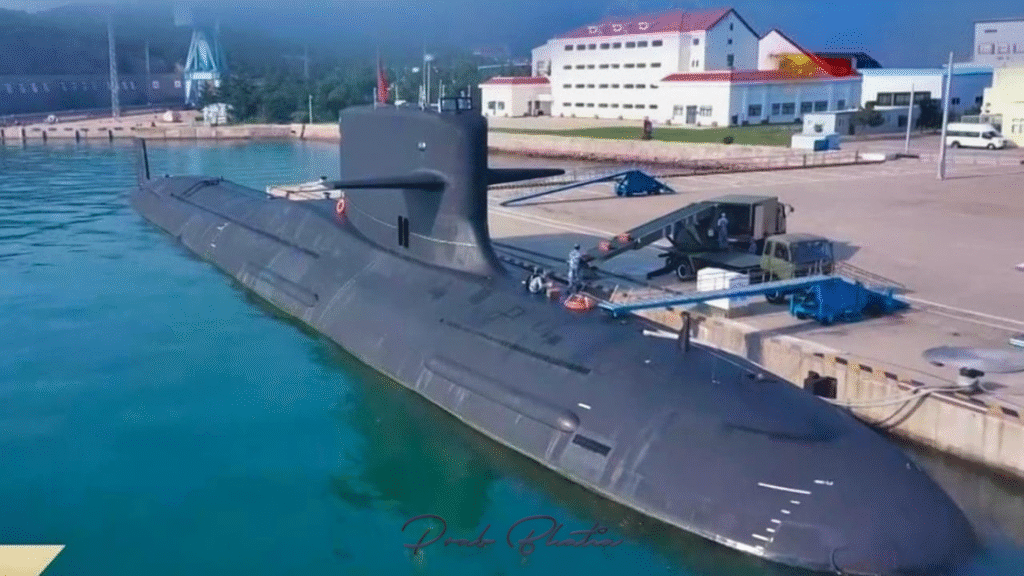
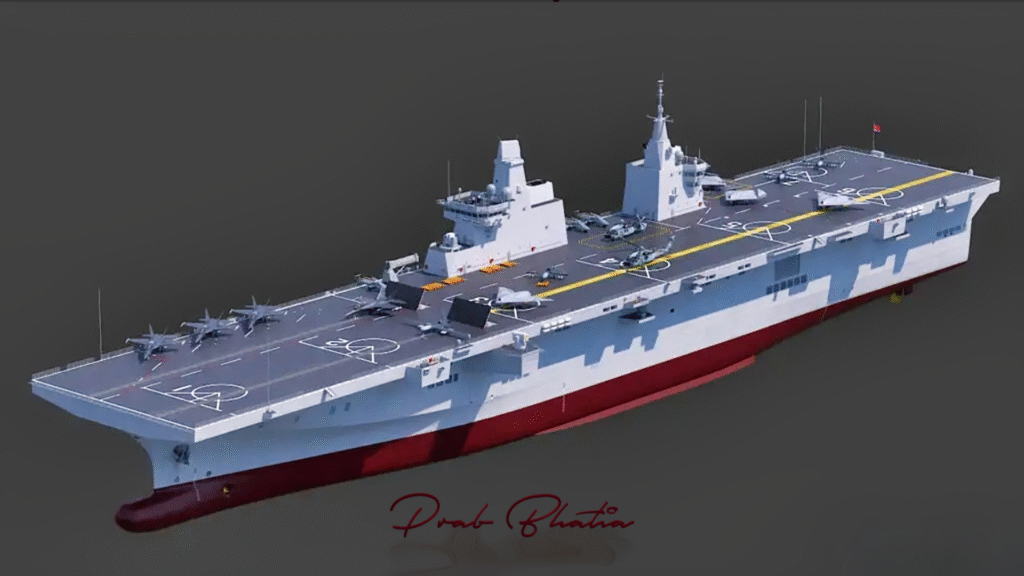
China’s transformation into the world’s shipbuilding superpower is one of the most dramatic industrial turnarounds in modern history. If South Korea’s shipbuilding ascent was forged through discipline and design mastery, China’s rise has been a story of sheer scale, state-backed acceleration, and strategic intent. In just two decades, China has transformed from a peripheral builder into the world’s largest shipbuilding nation by volume—producing everything from bulk carriers to aircraft carriers at a pace the world has never seen. This isn’t just industrial ambition; it’s a maritime doctrine. Backed by state subsidies, military-civil fusion, and a long-term vision to dominate global logistics and naval presence, China’s shipyards are now central to the country’s geopolitical playbook.
THE ORIGINS AND EVOLUTION OF CHINESE SHIPBUILDING
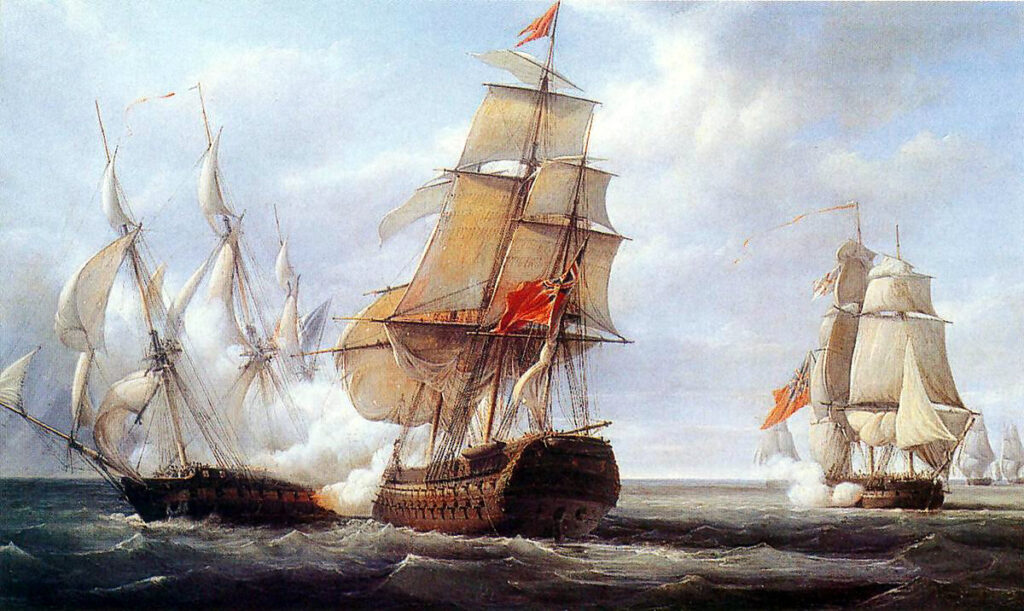
Chinese shipbuilding dates back thousands of years, with significant advancements during the Han, Tang, Song, and Ming dynasties. The iconic junk—a term used by Westerners to describe traditional Chinese sailing vessels—emerged as a dominant design by the Song dynasty (960–1279 CE) and reached its zenith during the Ming dynasty (1368–1644 CE).
Archimedes’ Principle
Archimedes’ principle—formulated in ancient Greece around 250 BCE—states that a body submerged in a fluid experiences an upward buoyant force equal to the weight of the fluid it displaces. While this principle underpins modern naval architecture, there is no evidence that ancient Chinese shipbuilders employed it explicitly.
Instead, Chinese shipbuilders relied on:
- Empirical observation of buoyancy and stability
- Generational craftsmanship passed down through guilds and families
- Practical experimentation with hull shapes, materials, and load distribution
Interestingly, the effectiveness of junk design suggests an intuitive grasp of buoyancy and hydrodynamics, even if not formally articulated.
Ancient Chinese junks were primarily built through empirical knowledge and craftsmanship, through centuries of trial, error, and refinement—not through formal scientific theory like Archimedes’—though their designs inherently reflected such principles.
TRANSITION TO MODERN SHIPBUILDING
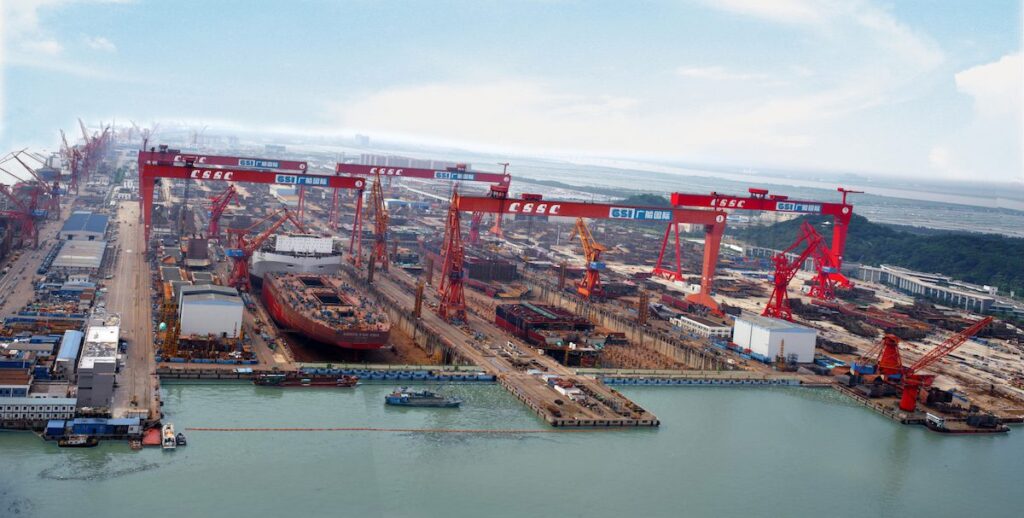
China’s entry into modern shipbuilding was relatively late, influenced by:
- The Opium Wars and Western imperialism, which exposed technological gaps
- The adoption of Western engineering during the late Qing and Republican periods
- The modernisation drives post-1949, culminating in China becoming a global shipbuilding powerhouse today
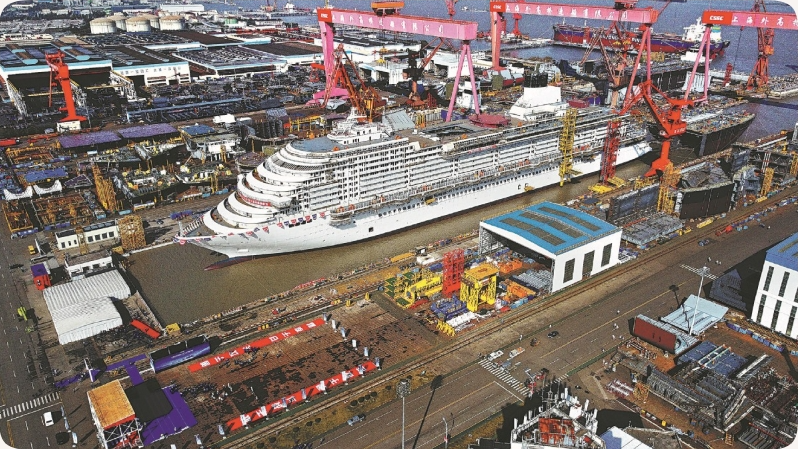
FROM OBSCURITY TO DOMINANCE: A TIMELINE OF CHINA'S SHIPBUILDING RISE
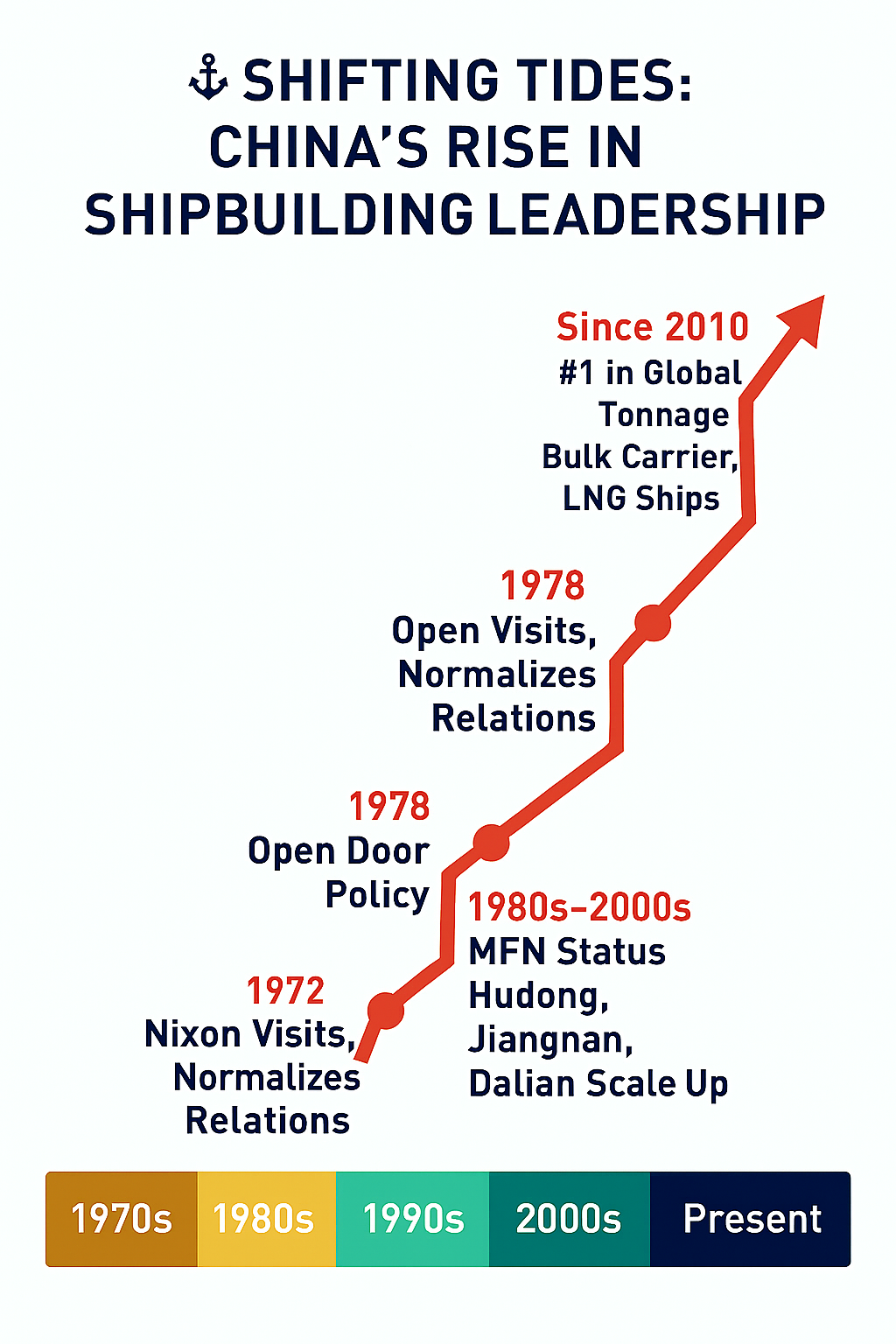
In the late 1970s, China’s shipbuilding industry was virtually non-existent on the global stage. But within four decades, it surged to become the largest shipbuilder in the world, producing over 50% of global commercial tonnage by the 2020s. But how did China achieve this?
CHINA’S SHIPBUILDING ODYSSEY: FROM FABRICATION TO SUPREMACY
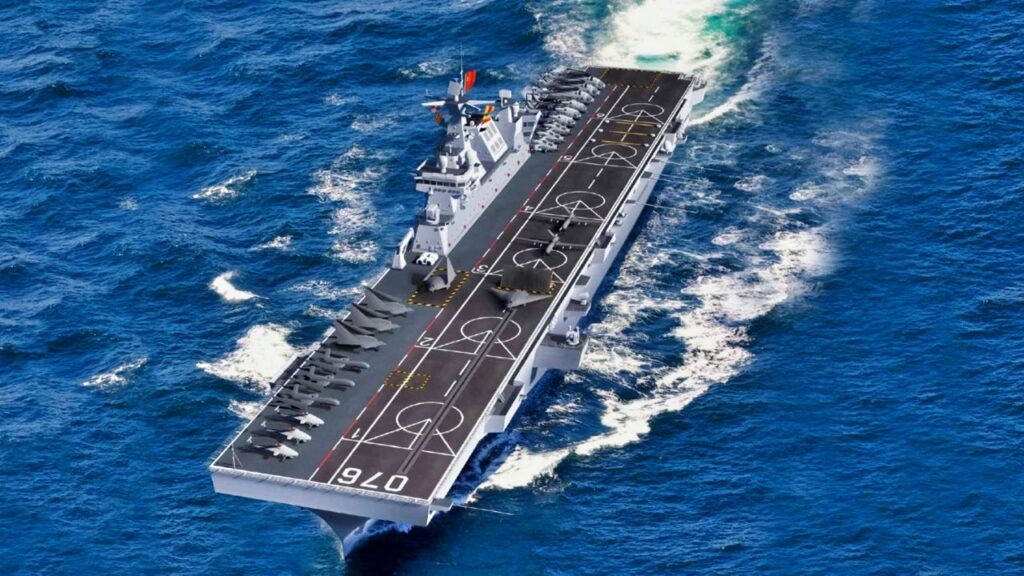
China’s transformation into the world’s top shipbuilder is the result of decades of strategic industrial policy, massive state investment, and technological leapfrogging—especially since the 2000s. This shift has indeed reshaped global power dynamics, particularly in maritime and economic spheres.
Here’s a breakdown of how this dramatic transformation unfolded:
Until the late 1970s, China’s shipbuilding industry was virtually non-existent on the global stage. But within four decades, it surged to become the largest shipbuilder in the world, producing over 50% of global commercial tonnage by the 2020s.
Here’s how that happened:
1. HUMBLE BEGINNINGS (1970s–1990s)
- Deng Xiaoping’s economic reforms of 1978 laid the groundwork for industrial modernisation, but shipbuilding remained a low-priority sector until the 1990s, overshadowed by consumer goods and light industry. Compared to Japan and South Korea—already exporting advanced bulk carriers and tankers—China’s shipyards were technologically limited, relying heavily on manual labour and outdated equipment.
- In 1980, following the normalisation of relations with the United States, China was granted Most Favoured Nation (MFN) trade status. This opened the door to global markets and gave Chinese exports a competitive footing, though shipbuilding itself lagged behind more urgent sectors.
- Foreign joint ventures were encouraged, especially in coastal cities like Shanghai and Dalian, where overseas expertise and capital began to trickle in.
- China started importing shipbuilding technology and sending engineers abroad for training, slowly building the foundations of technical capability.
- From personal experience, ships built during this era were poorly designed, with little emphasis on deep engineering or innovation. They were essentially fabrication projects: steel hulls assembled and fitted with imported machinery, rather than products of integrated design. This lack of indigenous design capability underscored the gap between China’s ambitions and its actual industrial capacity.
- Only in the 1990s did shipbuilding begin to gain strategic importance, laying the groundwork for the dramatic expansion to come.
“China’s shipyards of the 1970s and 80s were scaffolding for ambition—structures of steel without soul—waiting for the tide of destiny to carry them toward mastery.”
2. TRANSITIONAL ERA: FROM FABRICATION TO DESIGN (1990s – 2000s)
- Where ships of the 1970s and 1980s had been little more than steel hulls fitted with imported machinery, the 1990s marked a decisive shift. China’s leadership began to recognise shipbuilding as a strategic industry, tied not only to global trade ambitions but also to naval modernisation. Policy support and investment flowed into state-owned yards, signalling the transition from rudimentary fabrication toward the first serious efforts at indigenous design.
- Shipyards started experimenting with larger bulk carriers and oil tankers—often with foreign technical assistance—but now with the intent to master engineering processes rather than merely assemble parts.
- The government invested heavily in shipyards, especially in Shanghai, Jiangsu, and Liaoning.
- Dual-use facilities were developed to serve both commercial and military needs.
- State-owned enterprises (SOEs), notably China State Shipbuilding Corporation (CSSC), were consolidated and modernised.
- This period remained transitional: Chinese yards leaned heavily on overseas blueprints and technology transfers, yet the mindset was changing. Shipbuilding was no longer a peripheral craft—it was becoming a national project. The seeds of design capability, though modest, were planted, setting the stage for the rapid expansion and global competitiveness of the 2000s.
Anecdotal Reflection: When the first domestically designed bulk carriers rolled out of Chinese yards in the mid-1990s, they were celebrated less for their commercial performance than for what they symbolised. These ships were paraded as proof that China could move beyond mere fabrication, even if their efficiency and finish lagged global standards. For many in the industry, the launch ceremonies felt like national milestones—moments when the country declared its intent to stand shoulder‑to‑shoulder with established shipbuilding powers.
“The 1990s were China’s rehearsal stage, where imperfect ships carried perfect intent”
Yet as the 1990s closed, those imperfect ships carried a perfect intent—China was ready to move from rehearsal to performance, and nowhere would this be tested more profoundly than in the unforgiving theatre of LNG shipbuilding.
3. BREAKING INTO LNG: TRIALS AND LEARNING CURVES (2000s–2010s)
If the 1990s were China’s rehearsal stage, the LNG era was its first true performance. LNG carriers required precision far beyond that of bulk carriers or oil tankers—cryogenic containment systems, advanced propulsion, and stringent safety standards. For China’s shipyards, this was uncharted water: a test of whether ambition could meet engineering. Hudong Zhonghua Shipyard’s early projects in the 2000s were less about commercial success than about proving capability. Each vessel became a classroom, each launch, a lesson in LNG’s unforgiving discipline.
Personal Vantage Point: From my own experience at ABS London, I vividly recall the design packages for these early LNG carriers arriving on my desk for review and approval. The drawings revealed the steep learning curve Hudong faced: limited prior experience, reliance on imported machinery, and the daunting task of mastering cryogenic containment and safety systems unique to LNG vessels. In 2004, a group of Chinese engineers came to ABS for training in the design review process—a symbolic moment of knowledge transfer. It underscored both the challenges and the determination of China’s shipbuilding industry. Each blueprint was not just a technical document, but a declaration of intent to stand on equal footing with the world’s most advanced yards.
4. THE PRICE OF AMBITION
In the early 2000s, China’s shipbuilding ambitions collided with harsh realities. At Hudong‑Zhonghua Shipyard, a 600-ton gantry crane collapsed, killing 36 workers—an unflinching reminder of the human cost behind rapid industrial expansion. Yet this tragedy did not stall China’s momentum. Instead, it catalysed reforms in safety protocols, engineering standards, and workforce training.
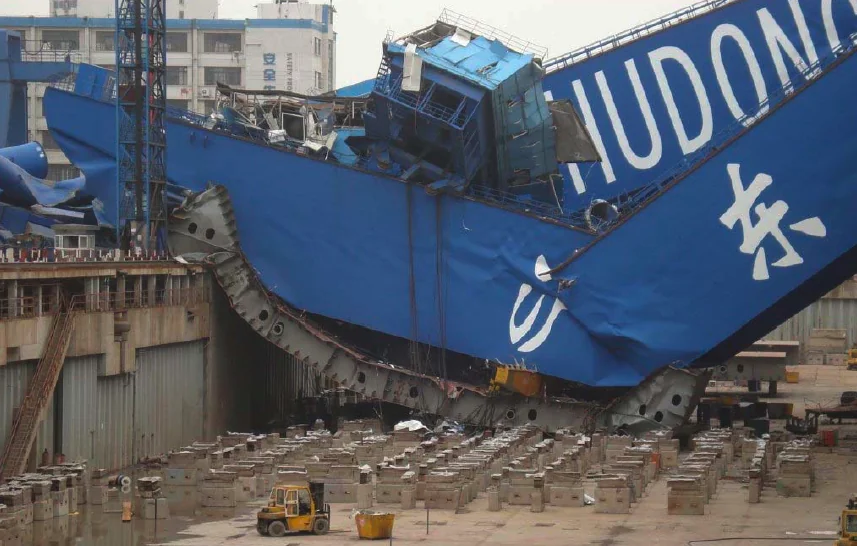
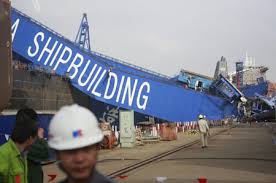
The nation doubled down on its commitment to build not just ships, but a sovereign industrial base. Today, Hudong stands as a global leader in LNG carrier construction—a testament to resilience forged in steel and sacrifice.
- China’s entry into the WTO in 2001 opened global markets, and shipbuilding was identified as a strategic industry.
- The government launched massive subsidies, tax incentives, and infrastructure investments to modernise shipyards and attract foreign orders.
- By the early 2000s, China sought entry into one of the most technically demanding segments of shipbuilding: LNG carriers. Hudong Zhonghua was tasked with building the country’s first five LNG vessels for BP—a project that marked China’s ambition to compete with established builders in Korea and Japan.
- Meanwhile, in Korea, the contrast was stark. Between 2005 and 2011, I was directly involved in building a fleet of 45 of the world’s largest LNG carriers at the three major Korean shipyards for Qatargas. While Korea delivered at scale and speed, Hudong’s first five vessels stretched far beyond schedule, a stark contrast to Korea’s clockwork fleets.
Symbolic Reflection: Those first five LNG carriers at Hudong were less commercial triumphs than training vessels for a nation. They embodied China’s determination to step into the most demanding shipbuilding arena, even as the journey was riddled with delays and setbacks. While Korea’s yards delivered fleets with clockwork precision, Hudong’s slow progress symbolised something different: the forging of capability through trial. Each weld and redesign was not merely about ships—it was about China teaching itself to dream bigger, to move from fabrication toward mastery.
Persistence and Progress: That dogged persistence eventually bore fruit. By 2011, Hudong secured a contract with ExxonMobil/PNG for four Q‑Flex–type LNG carriers—smaller than the class we had already built in Korea, but significant. From my vantage point at MOL’s London office, I witnessed Hudong’s gradual progress. Though the road remained uneven, these projects marked China’s true entry into LNG shipbuilding—proof that persistence can turn rehearsal into performance, and performance into destiny.
5. FROM TRAINING VESSELS TO INDUSTRIAL DOMINANCE (2010s–2020s)
The classroom years of LNG had taught China hard lessons in patience, precision, and persistence. By the 2010s, those lessons began to bear fruit. Shipyards that once struggled with blueprints and borrowed machinery now stood at the threshold of industrial maturity. What had started as training vessels became stepping stones toward dominance: larger bulk carriers, complex tankers, and eventually LNG fleets that signalled China’s arrival on the global stage.
This was no longer a rehearsal. It was performance at scale—backed by state consolidation, massive investment, and a national resolve to transform shipbuilding from a peripheral craft into a pillar of industrial supremacy.
- The 2010s marked a turning point. Having endured the setbacks of its first LNG projects, Hudong and other Chinese yards began to consolidate lessons learned. The symbolic “training vessels” of the 2000s gave way to a more confident phase, where China sought not only to participate but to compete.
- Contracts with ExxonMobil/PNG and later projects proved Hudong could deliver, albeit at a slower pace than Korean rivals. Each completed LNG carrier was more than a ship—it was proof of accumulated knowledge, of engineers and designers who had moved from dependence on foreign blueprints to developing their own technical confidence.
- Korea’s yards still commanded the stage with unmatched scale and sophistication, yet China’s persistence began to alter the script of global shipbuilding. By the late 2010s, Chinese yards were no longer seen as peripheral learners; they were emerging as credible builders in LNG, offshore, and specialised vessels. The symbolism of the first five carriers had matured into an industrial reality: China was now scaling its shipbuilding capacity across commercial and naval sectors, positioning itself as a global heavyweight.
Symbolic Reflection: If the 2000s were about learning to dream, the 2010s were about proving those dreams could be built. Each LNG carrier launched from Hudong was not just steel and machinery—it was stature itself, a declaration that China’s shipbuilding industry had crossed the threshold from aspiration to capability, from fabrication without design to design with ambition, and now, to industrial dominance.
6. TECHNOLOGICAL LEAP AND GLOBAL CREDIBILITY (2010S–2020S)
The 2010s marked China’s decisive leap from ambition to credibility. Having endured the setbacks of its first LNG projects, Hudong and other yards began consolidating lessons learned. The “training vessels” of the 2000s gave way to a more confident phase, where China sought not only to participate but to compete.
- Policy Anchor – Made in China 2025: Launched in 2015, this initiative elevated shipbuilding into the same strategic tier as semiconductors, aerospace, and robotics. It reframed shipbuilding as a high-tech frontier, embedding it within China’s vision of technological self-reliance and global leadership.
- Pre-Merger Centralisation: Even before the formal merger of CSSC and CSIC, the state pushed for consolidation, reducing fragmentation and strengthening national champions. This structural shift laid the foundation for scaling capacity and concentrating expertise.
- Professionalisation of Marine Engineering: One of the wisest, under‑appreciated moves was the deliberate professionalisation of marine engineering through foreign study, PhD programs, and domestic R&D infrastructure. Chinese engineers were sent overseas for advanced training, many completing doctorates in naval architecture, hydrodynamics, and shipyard management. Some remained abroad, contributing to research in the U.S., Britain, and Europe, yet their work still fed back into China’s universities and technical institutes. Over time, China built its own model basins, simulation facilities, and domestic equipment manufacturing, embedding systems knowledge at home. The net effect was a steady push up the quality frontier: where early ships showed immaturity, systematic R&D and university–industry connections allowed rapid iteration and improvement. The dividends were not only industrial but academic—China’s universities rose in global rankings, reflecting the fusion of education, research, and industry.
- Complex Vessel Breakthroughs: Chinese yards moved beyond bulk carriers into LNG carriers, cruise ships, and naval platforms. Cruise ships, among the most intricate civilian vessels to design and build, became emblematic of China’s confidence in tackling the highest tiers of shipbuilding.
Symbolic Reflection: The 2010s were not just about proving dreams could be built—they were about proving those dreams could be scaled. Each complex vessel launched was a declaration that China’s shipbuilding industry had crossed into technological credibility, standing shoulder‑to‑shoulder with the world’s most advanced yards.
7. INDUSTRIAL AND GLOBAL STRATEGY (2020–PRESENT)
By the 2020s, China’s shipbuilding ambitions had fully matured, woven into the nation’s broader industrial and geopolitical strategy. What began as fabrication without design had transformed into industrial supremacy.
Policy Continuity – Made in China 2025: The initiative’s emphasis on advanced shipbuilding continued to guide the industry, ensuring alignment with national priorities of self-reliance and technological leadership.
Institutional Consolidation – CSSC + CSIC Merger: In 2019, the merger of China State Shipbuilding Corporation (CSSC) and China Shipbuilding Industry Corporation (CSIC) created a unified national champion. This consolidation concentrated expertise across commercial, naval, and offshore sectors, mirroring China’s wider industrial strategy of centralised power.
Technical Maturity: Chinese yards now produce LNG carriers, cruise ships, and advanced military platforms with growing confidence. Cruise ships, once a symbolic ambition, became proof of engineering sophistication.
Global Dominance – 2024: By 2024, China accounted for 55.7% of global ship completions, 74.1% of new orders, and 63.1% of order backlogs, maintaining its top global position for fifteen consecutive years.
Symbolic Reflection: If the 2000s were about learning to dream, and the 2010s about proving those dreams could be built, the 2020s are about commanding the stage. Each vessel launched today is not only steel and machinery but a statement of China’s global intent. Shipyards that once struggled with “training vessels” now define the rhythm of international shipping. The journey from humble beginnings to dominance is complete—and the next chapter will be about shaping the future of maritime technology itself.
8. THE COMPASS OF SUPREMACY
China’s shipbuilding journey is not merely industrial—it is psychological, symbolic, and strategic. The relentless pursuit of being number one in everything—from ship completions to Olympic medals, from rail networks to global infrastructure—reveals a deeper national impulse: the desire to shape destiny, not simply participate in it.
This drive is no accident. It is embedded in long-range planning, civilizational pride, and a worldview that spans decades, even centuries. Shipbuilding, in this context, becomes more than an industry—it is a maritime metaphor for ascendancy. Each vessel launched is a projection of capability, sovereignty, and ambition.
China’s geography may place it third in land area, behind Russia and Canada. Yet its assertive claims over the South China Sea—through artificial islands and maritime control—suggest a symbolic expansion. If these waters were counted as sovereign territory, China’s footprint would rival Canada’s, reshaping perceptions of its global stature.
But this hunger for supremacy, while rooted in effort and planning, also breeds unease. Neighbours watch with caution. Rivals respond with a counterstrategy. And the world wonders: Is greatness still greatness if it breeds fear?
Symbolic Reflection: Shipbuilding, in this light, becomes a compass—not just of steel and design, but of strategic direction. It points toward China’s vision of itself: not as a participant in global order, but as a shaper of it. Each vessel is more than maritime—it is metaphor, movement, mastery, and momentum.
9. STRATEGIC IMPLICATIONS AND GLOBAL TENSIONS
China’s shipbuilding supremacy is not only industrial—it is strategic. The same shipyards that produce LNG carriers and cruise ships also underpin naval modernisation, blurring the lines between civilian and military capability.
Military–Civil Fusion: Shipbuilding has become a pillar of naval expansion, with dual-use technologies ensuring that commercial advances feed directly into military strength.
Geopolitical Concerns: The U.S. and its allies view China’s maritime rise as a strategic challenge. The sheer scale and speed of growth raise alarms about supply chain dependencies, naval balance, and economic leverage.
Casus Belli? While not a direct cause for war, China’s shipbuilding dominance is a flashpoint in the broader rivalry with the U.S., especially in the Indo-Pacific. It is part of the contest over global maritime supremacy.
China’s shipbuilding story is therefore more than industrial success—it is a case study in how state-led capitalism, long-term planning, and global integration can rapidly transform a nation’s strategic position. It is also a reminder that economic power often precedes geopolitical influence.
10. CLOSING CODA: SHAPING THE FUTURE OF SHIPBUILDING
China’s dominance in shipbuilding today is not the end of the story—it is the beginning of a new chapter. The 2020s have brought fresh imperatives: decarbonisation, digitalisation, and geopolitics. Global shipping is under pressure to reduce emissions, adopt green fuels such as LNG, hydrogen, and ammonia, and integrate smart technologies for efficiency and safety.
Chinese shipyards are positioning themselves at the forefront of this transition. Projects in green vessels, hybrid propulsion, and digital ship design signal that the industry is moving beyond sheer scale into innovation-led leadership. At the same time, naval expansion and strategic contracts reinforce shipbuilding’s role as a geopolitical instrument, not just an industrial one.
Emerging Competition: Yet even as China positions itself at the forefront of green and digital shipbuilding, new rivalries are taking shape. Korea’s partnerships with the U.S. and India signal a fresh wave of joint ventures—combining advanced design with cheaper labour and newly opening shipyard capacity. If these ventures scale, China’s dominance could face erosion within the next 5–10 years. For China, the strategic question is whether to defend its supremacy from home or to extend it abroad—perhaps by establishing greenfield shipyards in India itself. Such a move would not only secure market share but also symbolically acknowledge India as the next crucible of shipbuilding.
Symbolic Reflection: If the 1970s were humble beginnings, the 2000s were about learning to dream, and the 2010s were about proving capability, then the 2020s are about shaping the future. China’s shipyards are no longer simply building ships—they are building the frameworks of tomorrow’s maritime world. Yet the horizon is no longer theirs alone: new crucibles are forming, and India may soon carry the torch of shipbuilding ambition.
EPILOGUE
“From steel without design to ships that shape destiny, China’s shipbuilding odyssey is a testament to trial, persistence, and triumph and a compass pointing toward the maritime future.”
A wonderful, insightful, precise, short but comprehensive snapshot of China’s shipbuilding journey over the last 5 decades. It captures the spirit, ambition and determination of a nation that has achieved dominance as a superpower in a highly complex technological and challenging design driven world of shipbuilding in a very simple but accurate account that should strike a chord and provide a guiding light to the other ambitious neighbouring countries, including India. Very well compiled and articulated Prab 👍
Thank you, Shrikant 🙏 Your words affirm the spirit of China’s ascent. Hopefully, this reflection will also serve as a guiding light for India’s own shipbuilding journey and for our wider community.
Thank you for this excellent, informative and authentic essay. Your experience at ABS leading to first hand experience of the industry comes through very well.
Thank you, Gopi 🙏 I truly appreciate your words—glad the piece resonated and sparked reflection.
Prab, great summary of the Chinese shipbuilding success story. After I retired from Qatargas in 2007, I was asked in 2008 to be a part of an ExxonMobil team to assess the Chinese shipyards capabilities to build LNG ships. We visited the Hudong shipyard and a KHI joint venture yard (the name escapes me). When we asked the Hudong shipyard to show us their design, they unrolled Korean design drawings. But by that time they had already proven that they could deliver LNG ships, maybe to the Korean design.
Subsequently, I was asked to head the project building LNG carriers at Hudong for ExxonMobil. At that point at 62, facing 80 hour work weeks and sleepless nights, I decided that was a job for somebody with a lot more energy than I had left in me. But as you mentioned, they delivered, but for the construction supervision team, it was money well earned. Regardless how hard and long was the rise for the Chinese to become number one shipbuilding nation, an amazing achievment.
As for the Korean-US ambitious plans to revive the US shipbuilding, it is good money thrown after a bad project. Short of, God forbid, an all out war, I do not see a significant rise in the US commercial shipbuilding in the next 20 years, if ever.
Jay
So nice to hear your first-hand account, Jay. I believe the other shipyard you visited was NACKS—the Nantong COSCO/KHI joint venture. I recall reading your audit report when I was attached to the Exxon-PNG project, alongside the late Dave Jones, whom you may remember from Exxon.
It’s fascinating that Hudong presented what resembled a smaller version of the Korean Q-Flex design. At the time, many of us noted how closely those drawings mirrored the Korean work, and there were even stories circulating about questionable transfers of design material. One case involved a Chinese surveyor at Samsung who was detained in Busan with plans on his computer. But as you rightly say, all that is history now.
China’s real breakthrough came from its strategic policies—insisting that if you wanted to sell gas to China, you had to build ships there. That foresight, combined with sheer persistence, propelled them to the top of the shipbuilding world.
I admire your decision to step back at 62, choosing health and peace over the grind of 80-hour weeks. And on your point about US–Korea ambitions, I fully concur. That will be the subject of my next blog.