In the marine industry, few terms are more casually conflated—and more consequential—than “rules” and “regulations.” Understanding the difference isn’t just academic; it’s essential for shipowners, builders, surveyors, and compliance officers navigating global waters.
REGULATIONS: STATUTORY, BINDING, AND ENFORCEABLE
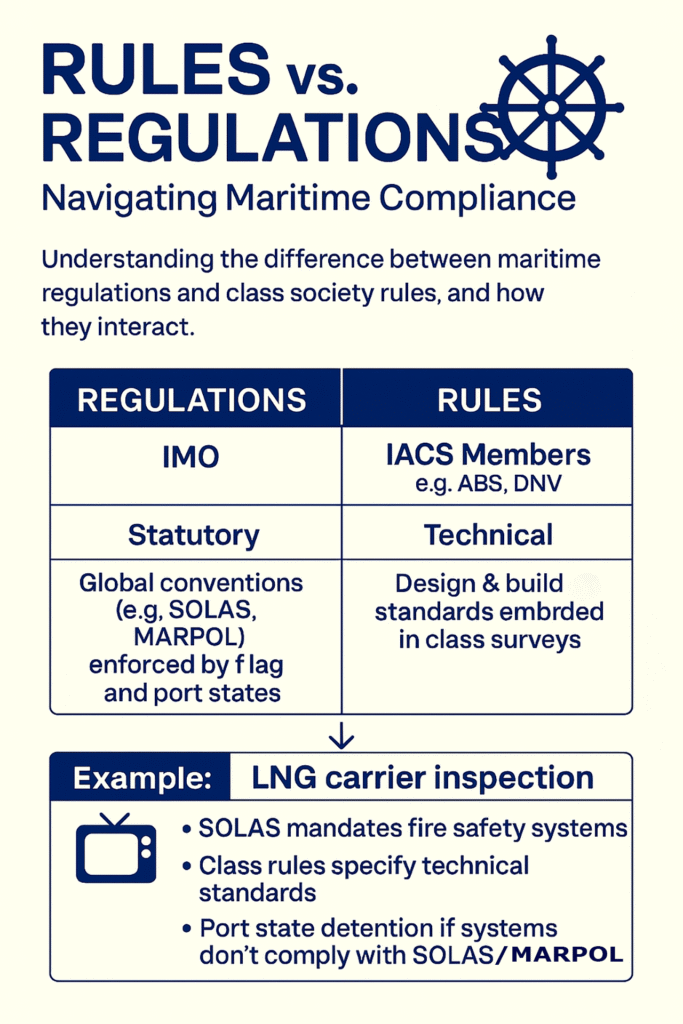
Regulations are legal instruments — typically international conventions developed by the International Maritime Organisation (IMO). Once ratified by a flag state, they become statutory law for vessels flying that flag.
KEY EXAMPLES
SOLAS (Safety of Life at Sea): Fire protection, lifeboats, navigation systems
STCW (Standards of Training, Certification and Watchkeeping): Crew qualifications
ISPS (International Ship and Port Facility Security): Anti-terrorism protocols
ENFORCEMENT
Flag States issue certificates and conduct audits
Port States (e.g., U.S. Coast Guard, EU Paris MoU) inspect foreign vessels
Non-compliance can lead to detention, fines, or loss of trading rights
RULES: TECHNICAL STANDARDS FROM CLASS SOCIETIES
Rules are developed by IACS members, including classification societies such as DNV, ABS, and Lloyd’s Register. These are technical standards that govern the design, construction, and maintenance of ships.
KEY FUNCTIONS
Structural integrity (hull, tanks, bulkheads)
Machinery systems (engines, pumps, LNG containment)
Survey regimes (annual, intermediate, renewal)
LEGAL STATUS
Not statutory, but contractual — shipowners voluntarily enrol with a class society
Embedded IMO compliance: Class rules often incorporate IMO requirements to ensure ships meet both technical and legal standards
HOW THEY INTERACT: A REAL-WORLD EXAMPLE
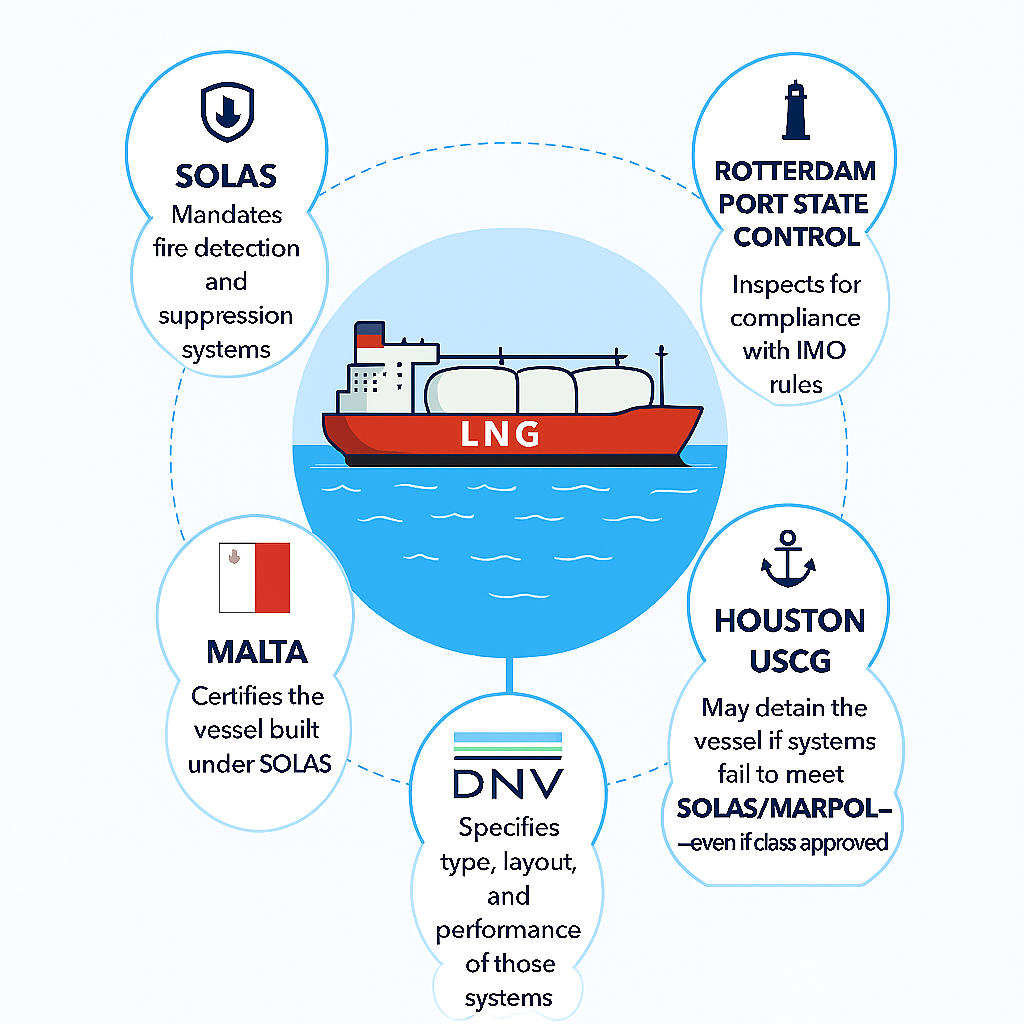
Imagine an LNG carrier built in South Korea, flagged in Malta, and operating between Rotterdam and Houston:
SOLAS mandates fire detection and suppression systems
MARPOL mandates marine pollution laws applied to ships
DNV Rules specify the type, hull and machinery design per their rules, layout, and performance of those systems and carry out periodic surveys
Malta certifies the vessel under SOLAS
Rotterdam Port State Control inspects for compliance
Houston USCG may detain the vessel if systems fail to meet SOLAS/MARPOL—even if class-approved
8 thoughts on “RULES VS. REGULATIONS: NAVIGATING MARITIME COMPLIANCE”

Good explanation.
Thank you, Prem.
Great recap
Thanks PS
Thanks, Suren. Please keep sharing your thoughts for upcoming blogs too.
Thanks PSB, for the clarification.
This info will help me when I conduct Orals ( as an External Examiner) for MEO Class 2 candidates.
Glad to hear it helps, Bunny! Great to see you making a difference. Best of luck with your MEO Class 2 Orals. Would love to hear your thoughts.
Thanks Jyoti . Very well explained .
Thanks, Naresh. Your thoughts are important to me. Please do read forthcoming blogs and share your thoughts.